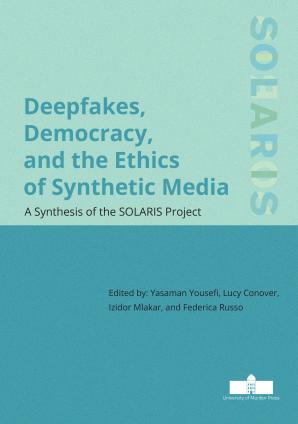
Deepfakes, Democracy, and the Ethics of Synthetic Media: A Synthesis of the SOLARIS Project
Keywords:
synthetic content, democracy, generative artificial intelligence, deepfakes, disinformation, epistemic erosion, ethics in artificial intelligence, media literacy, democratic resilience, synthetic media for social goodSynopsis
This book presents an interdisciplinary synthesis of research findings from the Horizon Europe project SOLARIS. It systematically examines deepfake technologies as a structural threat to democratic institutions. Eight chapters integrate technological, psychometric, semiotic, legal, and political science perspectives, empirically analyzing both epistemic risks and potential positive applications of synthetic media. The authors critically examine generative neural network architectures, viral propagation mechanisms of disinformation in digital networks, and cognitive-affective factors in perceived trustworthiness of AI-generated content. The work identifies deepfake impacts on electoral integrity, epistemic erosion of public discourse, and asymmetric effects on marginalized populations. Critical evaluation of European regulatory instruments (AI Act, DSA) leads to formulation of innovative policy recommendations for systemic resilience of democratic processes. The research also documents positive implementations of synthetic media in pedagogical, cultural-documentary, and civic engagement contexts. This publication manily targets the research community, policymakers, media professionals, and technological actors.
Chapters
-
Unmasking the IllusionThe Tech Behind Deepfakes
-
The Spread of Deepfakes in Digital Networks
-
Semiotics of Synthetic Media
-
The Psychology of DeceptionWhy We Believe Deepfakes
-
Democracy Distorted –Deepfakes as Political Weapons
-
Synthetic Media for Social GoodUnlocking Positive Potential
-
Governing DeepfakesLegal Initiatives and Regulatory Gaps
-
Regulatory Innovations and Policy Options for Synthetic Media and Digital Democracy
Downloads
Download data is not yet available.
Published
February 10, 2026
Categories
Copyright (c) 2026 University of Maribor, University of Maribor Press

Details about the available publication format: E-book (pdf)
E-book (pdf)
ISBN-13 (15)
978-961-299-109-8
COBISS.SI ID (00)
THEMA Subject Codes (93)
PDR, JBFV, UZQ, JBFM, GTXD
Date of first publication (11)
2026-02-10
Details about the available publication format: Hardback (in print)
Hardback (in print)
ISBN-13 (15)
978-961-299-110-4
COBISS.SI ID (00)
THEMA Subject Codes (93)
PDR, JBFV, UZQ, JBFM, GTXD
Date of first publication (11)
2026-02-10
Physical Dimensions
16.5cm x 23.5cm x 1.6cm
How to Cite
Yousefi, Y., Conover, L., Mlakar, I., & Russo, F. (Eds.). (2026). Deepfakes, Democracy, and the Ethics of Synthetic Media: A Synthesis of the SOLARIS Project. University of Maribor Press. https://doi.org/10.18690/um.feri.2.2026