Synthetic Media for Social Good: Unlocking Positive Potential
Kratka vsebina
This chapter examines the ethical, communicative, and societal dimensions of artificial intelligence for social good (AISG) through a series of participatory workshops conducted in collaboration with the European Citizen Science Association (ECSA). The workshops engaged 44 participants from 18 national backgrounds, selected according to age, gender balance, and domain expertise, and addressed emotionally and epistemically sensitive domains, including climate change communication, the visibility of women in science, and AI-mediated psychological support. The analysis identifies four determinants shaping perceived impact: narrative–intentional coherence, technical–mimetic realism, ethical transparency, and contextual adequacy. Together, these dimensions inform a preliminary set of ethical and design guidelines for socially engaged and educational media. The chapter further proposes a methodological framework that combines semiotic modelling with iterative user testing to evaluate AI-generated content beyond criteria of realism or imitation. By foregrounding communicative function, ethical clarity, and cultural resonance, the findings suggest that synthetic media can meaningfully contribute to socially oriented and educational contexts when designed with participatory and ethically grounded approaches.
Prenosi
Strani
123-140
Izdano
10.02.2026
Kategorije
Avtorske pravice (c) 2026 Univerza v Mariboru, Univerzitetna založba

Kako citirati
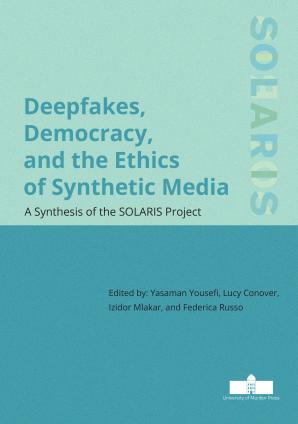
Tumminelli, A., Conover, L., Caltagirone, C., Bassano, G., Rakipi, G., & Tonello, T. (2026). Synthetic Media for Social Good: Unlocking Positive Potential. In Y. Yousefi, L. Conover, I. Mlakar, & F. Russo (Eds.), Deepfakes, Democracy, and the Ethics of Synthetic Media: A Synthesis of the SOLARIS Project (pp. 123-140). Univerzitetna založba Univerze v Mariboru. https://doi.org/10.18690/um.feri.2.2026.6