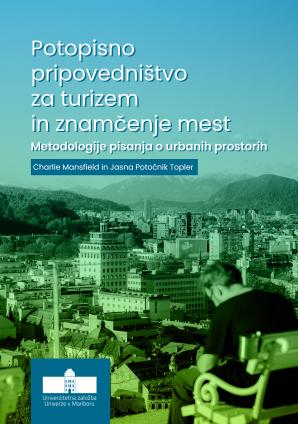
Potopisno pripovedništvo za turizem in znamčenje mest: Metodologije pisanja o urbanih prostorih
Keywords:
teaching, travel writing, movement, sign languages and non-verbal communication, curriculumSynopsis
Travel Writing for Tourism and City Branding: Urban Place-Writing Methodologies. The monograph contributes to the professionalisation of travel writing. Its approach establishes a new connection between tourism and city branding, which will encourage new travel writers and bloggers to produce thoughtful, high-quality content. The book demonstrates that literary travel writing is a research process that an author–researcher can apply in spaces where value is created. This research process extracts, preserves and communicates that value, while also serving the writer as a tool for in-depth exploration of place. Travel writing as research is presented as a methodological practice that researchers can learn and apply in their projects, both in academic contexts and in the commercial context of city branding. Examples of literary travel writing from the authors’ research projects are examined, and their effects are further analysed. The monograph contributes new insights, also by including research findings on urban spaces obtained through this new method.
Downloads
Download data is not yet available.
References
Agarwal, S. & Shaw, G. (2018). Heritage, Screen and Literary Tourism. Bristol: CVP.
Agueda, B. (2014). 'Urban restructuring in former industrial cities: urban planning strategies', Territoire en mouvement : Revue de géographie et aménagement
Alegre, J., Garau, J. (2010). ‘Tourism satisfaction and dissatisfaction’. Annals of Tourism Research, 37 (1), 52–73.
Althusser, L. (1971). 'Ideology and Ideological State Apparatuses' in Lenin and Philosophy, and Other Essays. Trans. Ben Brewster. London: New Left Books, pp. 121–173.
Alu, Giorgia & Hill, Sarah Patricia (2018). The travelling eye: reading the visual in travel narratives, Studies in Travel Writing, 22 (1), 1–15, DOI: 10.1080/13645145.2018.1470073
Anderson, L. (2006). Analytic autoethnography. Journal of Contemporary Ethnography, 35, 4, 373–395.
Andrades, L., & Dimanche, F. (2014). Co-creation of experience value: A tourist behaviour approach.
In M. Chen & J. Uysal (Eds.), Creating experience value in tourism (pp. 95–112). London: CABI.
doi:10.1079/9781780643489.0095
Ansell-Pearson, K. (2010). Deleuze and the Overcoming of Memory. In S. RADSTONE & B. SCHWARZ (Eds.), Memory: Histories, Theories, Debates (pp. 161–174). New York: Fordham University Press.
Antosa, S. (2008). Formal and Thematic Influence of Travel Writing on the Novel: From the Pilgrims’ Accounts to Gothic Fiction. Fogli di anglistica, 2 (3–4), 55–66.
Aristotle (trans. Butcher, S. H.). (2008). The Poetics of Aristotle.
Assaker, G. (2020). Age and gender differences in online travel reviews and user-generated-content (UGC) adoption: extending the technology acceptance model (TAM) with credibility theory. Journal of Hospitality Marketing & Management, 29(4), 428–449. https://www.tandfonline.com/doi/abs/10.1080/19368623.2019.1653807, 13. 6. 2022.
Austin, L. (2007). ‘Aesthetic embarrassment: The reversion to the picturesque in nineteenth-century English tourism’. ELH, 74(3), 629–653.
Aydin, G. (2020). Social media engagement and organic post effectiveness: A roadmap for increasing the effectiveness of social media use in hospitality industry. Journal of Hospitality Marketing & Management, 29(1), 1–21.
Azevedo, A. (2009). 'Are you proud to live here? A residents oriented place marketing audit (attachment, self-esteem and identity)' Minho University, Braga, Portugal.
Barthes, R. (1983). Empire of Signs. New York: Hill & Wang.
Barthes, R. (1988). Roland Barthes by Roland Barthes. London: Macmillan.
Bassano, C., Barile, S., Piciocchi, P., Spohrer, J. C., Iandolo, F., Fisk, R. (2019). Storytelling about places: Tourism marketing in the digital age. Cities, 87, 10–20.
Beaufort, A. (2004). ‘Developmental Gains of a History Major: A Case for Building a Theory of Disciplinary Writing Expertise’. Research in the Teaching of English, 39(2), 136–185.
Bechmann Petersen, A. (2006). Internet and cross media productions: Case studies in two major Danish media organizations. Australian Journal of Emerging Technologies and Society, 4(2), 94–107.
Belsey, C. (1980) Critical Practice, London: Routledge.
Benjamin, W. (2019). The Storyteller Essays. New York: New York Review Books.
Bernstein, J. (1995). Recovering Ethical Life. London, Routledge
Bertella, G. (2014). The co-creation of animal-based tourism experience. Tourism Recreation
Research, 39(1), 115–125.
Bilynets, I., Knežević Cvelbar, L., Dolnicar, S. (2021). ‘Can publicly visible pro-environmental initiatives improve the organic environmental image of destinations?’ Journal of sustainable tourism.
Bitchener, J., Basturkmen, H., & East, M. (2010). ‘The focus of supervisor written feedback to the-
sis dissertation students’. International Journal of English Studies, 10(2), 79–97. https://doi.org/10.6018/ijes/2010/2/119201
Blanchot, M. (1998) 'The Sirens' Song' Trans. Lydia Davis. The Station Hill Blanchot Reader. New York, Station Hill, pp. 443–450.
Blaće, D., Ćorić, G. & Jurić, B. (2015). ‘Branding the city of Šibenik as a sustainable tourist destination using social networks’. Ekonomski vijesnik, 28, Special Issue, 109–125.
Bourdieu, P. (1977). Outline of a Theory of Practice, Cambridge, Cambridge University Press.
Bourdieu, P. & Passeron, J. (1990). Reproduction in education, society and culture (Theory, culture and society series). London: Sage
Buonincontri, P., Micera, R. (2016). The experience co-creation in smart tourism destinations: a multiple case analysis of European destinations. Inf Technol Tourism 16, 285–315. https://doi.org/10.1007/s40558-016-0060-5, 15. 6. 2022.
Buonincontri, P., Morillo, A., Okumus, F., van Niekerk, M. (2017). Managing the experience co-creation process in tourism destinations: Empirical findings from Naples. Tourism Mangement, Vol. 62, 264–277.
Braidotti, R. (2019). Posthuman Knowledge, Cambridge: Polity.
Brewer, W.F. and E.H. Lichtenstein, 1982. Stories are to entertain: A structural–affect theory of stories. Journal of Pragmatics 6, 473–486.
Bright, D. (2018). ‘Writing Posthumanist Subjects’, Qualitative Inquiry, 24(10), 751–758.
Brown, G. (2005). Mapping Spatial Attributes in Survey Research for Natural Resource Management: Methods and Applications. Society and Natural Resources, 18, 1, 17–39.
Bruhn, M., Schoenmueller, V., Schäfer, B. Daniela. (2012). Are social media replacing traditional media in terms of brand equity creation? Management Research Review, 35 (9), 770–790.
Brunt, P. (1997). Market Research in Travel and Tourism, Oxford, Butterworth Heinemann.
Burbules, N. (1993). Dialogue in Teaching: Theory and Practice. New York: Teachers College Press.
Busby, G., Klug, J. (2001). Movie-induced tourism: The challenge of measurement and other issues. Journal of Vacation Marketing, 7, 4, 316 – 332.
Campos, A. C., Mendes, J., Oom do Valle, P. & Noel Scott (2018). Co-creation of tourist experiences: a literature review, Current Issues in Tourism, 21:4, 369–400, DOI: 10.1080/13683500.2015.1081158
Carla (2015) Goodreads Book Reviews [Online} Accessed 23/04/2022 Available at < https://www.goodreads.com/review/show/1252948719?book_show_action=true&from_review_page=1>
Carlson, A. (2002). Environmental aesthetics. In Gaut, B., Lopes McIver D. (Ed.). 2002. The Routledge Companion to Aesthetics, 2nd Edition.. London and New York: Routledge, pp. 541–555.
Carter, S., Kumar, V. (2017). ‘Ignoring me is part of learning’: Supervisory feedback on doctoral writing. Innovations in Education & Teaching International, 54(1), 68–75.
https://doi.org/10.1080/14703297.2015.1123104
Certeau, M. (1984). The practices of everyday life (S. F. Rendall, trans.). Berkeley: University of California Press.
Chang, T. C. (1997). From “instant Asia” to “multi-faceted jewel”: Urban imaging strategies and tourism development in Singapore. Urban Geography, 18(6) 542–562.
Chaxel, S., Fiorelli C., Moity-Maïzi, P. (2014). 'Les récits de vie : outils pour la compréhension et catalyseurs pour l'action' Interrogations,17. L'approche biographique.
Cheng, Y., Wei, W., & Zhang, L. (2020). Seeing destinations through vlogs: implications for leveraging customer engagement behavior to increase travel intention. International Journal of Contemporary Hospitality Management. https://www.emerald.com/insight/content/doi/10.1108/IJCHM-04-2020-0319/full/html, 13. 6. 2022.
Charmaz, K. (2014). Constructing Grounded Theory, Thousands Oaks: Sage.
Coates, C. (2014). 'All alive on the Loire: Art, architecture and elephants in Nantes' in Mail Online – Travel Mail, London, DMG Media Ltd, Accessed 25.6.2022 Available at http://www.dailymail.co.uk/travel/article-2539767/Francecity-breaks-Nantes-French-fantasy.html
Coghlan, A. & Filo, K. (2013). 'Using constant comparison method and qualitative data to understand participants' experiences at the nexus of tourism, sport and charity events' Tourism Management 35: 122–131.
Culbert, J. (2018). Theory and the limits of travel, Studies in Travel Writing, 22 (4), 343–352.
Dann, G. (1996). The language of Tourism: A Sociolinguistic Perspective. Wallingford: CAB International.
Darling-Hammond, L., Flook, L., Cook-Harvey, C., Barron, B. & Osher, D. (2020). Implications for educational practice of the science of learning and development, Applied Developmental Science, 24:2, 97–140, DOI: 10.1080/10888691.2018.1537791
Delcroix, C. & Inowlocki, L. (2008). 'Biographical Research as a Cognitive and Practical Approach for Social Workers: An Interview with Catherine Delcroix.' Forum: Qualitative Social Research, 9(1), Art. 60.
Deleuze, G. & Guattari, F. (1987). A Thousand Plateaus, Minneapolis: University of Minnesota Press.
Dettori, A., Giudici, E. & Aledda, L. (2016): Sharing experiences in tourism: what role can social media play? XXVIII Sinergie Annual Conference Referred Electronic Conference Proceeding Management in a Digital World. Decisions, Production, Communication ISBN 97888907394-6-0, 9-10 June 2016, University of Udine (Italy), DOI 10.7433/SRECP.FP.2016.04
Di, F., Yang, Z., Liu, X. et al. Chin. Geogr. Sci. (2010). 20: 59. doi:10.1007/s11769-010-0059-3
Dijkstra, K., Zwaan, R. A., Graesser A. C., Magliano, J. P. (1995). Character and reader emotions in literary texts, Poetics, Volume 23, Issues 1–2, 139–157, https://doi.org/10.1016/0304-422X(94)00009-U
Dixon, P., Bortolussi, M., Twilley, L., & Leung, A. (1993). Literary processing and interpretation: Toward empirical foundations. Poetics, 22, 5–33. doi:10.1016/0304-422X(93)90018.
Dolnicar, S. (2020). ‘Designing for more environmentally friendly tourism’. Annals of Tourism Research, 84, art. 102933, 1–10, doi: 10.1016/j.annals.2020.102933.
D’Orey, F., Cardoso, A., Abreu, R. (2019). “Tourist’ Sense of Place”, an Assessment of the Sense of Place in Tourism Studies: The Case of Portugal. Academy of Strategic Management Journal, 18, 1.
Dowling, W. (2011). Ricœur on Time and Narrative – An Introduction to Temps et récit, Notre Dame Indiana: University of Notre Dame.
Duffy, E. B., Poell, T., Nieborg, D. B. (2019). Platform Practices in the Cultural Industries: Creativity, Labor, and Citizenship. Social Media + Society, 5, 4, 1–8. https://journals.sagepub.com/doi/full/10.1177/2056305119879672, 26. 5. 2022.
Dunford, M. (2013). Friuli-Venezia Giulia Rough Guides Snapshot Italy (includes Trieste, Aquileia, Grado, Gorizia, Udine and Cividale del Friuli), London: Rough Guides APA Ltd.
Dwyer,L., Chen, N., Lee, J. (2019). The role of place attachment in tourism research, Journal of Travel & Tourism Marketing, 36:5, 645–652.
Ekblaw, E. (1937). ‘The Attributes of Place’. Journal of Geography, 36, 6, 213–220.
Eshuis, J., Klijn, E. & Braun, E. (2014). 'Place marketing and citizen participation: branding as strategy to address the emotional dimension of policy making' International Review of Administrative Sciences 80(1), 151–171.
Evans, C. (2013). Making sense of assessment feedback in higher education. Review of Educational Research, 83(1), 70–120.
Ferguson, S. (2018). Diaries Real and Fictional in Twentieth-Century French Writing. Oxford: OUP.
FERRER-ROCA, N., WESTON, R., GUIA, J., MIHALIČ, T., BLASCO, D., PRATS, L., LAWLER, M., JARRATT, D. (2021). ‘Back to the future : challenges of European tourism of tomorrow’. Journal of tourism futures, 7(2) 184–191, doi: 10.1108/JTF-10-2019-0114.
Fialho, O. & Kuzmicova, A. (Reviewing editor). (2019). What is literature for? The role of transformative reading, Cogent Arts & Humanities, 6:1, DOI: 10.1080/23311983.2019.1692532, 13. 1. 2021.
Figurski, T.J., 1987. Self-awareness and other-awareness: The use of perspective in everyday life. In: K. Yardley and T. Honess (eds.), Self and identity: Psychosocial perspectives. Chichester: Wiley.
Forgas, J.P., 1981. Affective and emotional influences on episode representation. In: J.P. Forgas (ed.), Social cognition: Perspectives on everyday understanding, 165–180. London: Academic Press.
Forsdick, C. (2009). Introduction: contemporary travel writing in French: tradition, innovation, boundaries, Studies in Travel Writing, 13 (4), 287–291.
Foucault, M. (1983). 'Self Writing' Dits et écrits, Vol 4, pp. 415–430.
Foucault, M. (1970). The Order of Things; An archaeology of the human sciences London: Routledge.
Foucault, M. (1966). Les mots et les choses Paris: Gallimard.
Friedland, R., Boden, D. (1994). NowHere: Space, Time and Modernity. Berkley: University California Press.
Gale, K. (2018). Madness as Methodology, Abingdon: Routledge.
Gale, N., Heath, G., Cameron, E., Rashid, S. & Redwood, S. (2013). 'Using the framework method for the analysis of qualitative data in multi-disciplinary health research.' BMC Medical Research Methodologies 13(117).
Gentile, R., Brown, L. (2015). A Life as a Work of Art: Literary Tourists' Motivations and Experiences at Il Vittoriale degli Italiani, 6, 2, 25 – 47.
George, B. (2012). Past visits and the intention to revisit a destination: Place attachment as the mediator and novelty seeking as the moderator.
Gide, A. (1925) Les Faux-Monnayaeurs, Paris: Gallimard.
Gide, A. (1895) Paludes, Paris: Librairie de l'art.
Gieryn, T. (2000). A Space for Space in Sociology. Annual Review of Sociology, 26, 463–496.
Gillan, A. (2021). 'Eat Nantes' in National Geographic Traveller, London, APL Media. Online, Accessed 25.6.2022 Available at http://www.natgeotraveller.co.uk/destinations/europe/france/eat-nantes/
Gillespie, T. (2010). The politics of “platforms.” New Media & Society, 12, 347–364. doi:10.1177/1461444809342738
Godsil, R. & B. Goodale.(2013). Telling Our Own Story: The Role of Narrative in Racial Healing. W. K. Kellogg Foundation.
Graham S. (2019). Changing How Writing Is Taught. Review of Research in Education, 43, 1, 277–303. doi:10.3102/0091732X18821125
Greco, F. (2018). The Rule of Persuasion in the Marketing Process. Psyhology and Behavioral Science International Journal. Vol. 9., No. 5, DOI: 10.19080/PBSIJ.2018.09.555775, https://juniperpublishers.com/pbsij/pdf/PBSIJ.MS.ID.555775.pdf, 13. 6. 2022.
Grenni, S., Horlings, L., & Soini, K. (2020). Linking spatial planning and place branding strategies through cultural narratives in places, European Planning Studies, 28, 7, 1355–1374.
Gretzel, U., Fesenmaier, D. R., & O’Leary, J. T. (2006). The transformation of consumer behaviour. In
D. Buhalis & C. Costa (Eds.), Tourism business frontiers: Consumers, products and industry (pp. 9–18). Oxford: Butterworth-Heinemann
Gustafson, P. (2001). Meanings of place: Everyday experience and theoretical conceptualizations, 21, 1, 5–16.
Haskoning D. (2020). Update on the Current state of Knowledge on the Environmental Impacts of Offshore Wind Farms, Exeter: Haskoning DHV.
Haughney, K., Wakeman, S., Hart, L. (2020). Quality of Feedback in Higher Education: A Review of Literature. Education Sciences 10, no. 3: 60. https://doi.org/10.3390/educsci10030060
Heller, M., Jaworski, A., Thurlo, C. (2014). Introduction: Sociolinguistics and tourism – mobilities, markets, multilingualism. Journal of Sociolinguistics, 18 (4), 425–458.
Henderson, M., Phillips, M., Ryan, T., Boud, D., Dawson, P., Molloy, E. & Mahoney, P. (2019). Conditions that enable effective feedback, Higher Education Research & Development, 38:7, 1401–1416, DOI: 10.1080/07294360.2019.1657807
Herbert, D. (1995). Heritage, Tourism and Society. London: Pinter.
Hidalgo, M., Hernandez, B. (2001). Place attachment: Conceptual and empirical questions. Journal of Environmental Psychology, 21,273–281.
Holland, P., Huggan, G. (2000). Tourists with Typewriters: Critical Reflections on Contemporary Travel Writing. Ann Arbor: University of Michigan Press.
Hopfenbeck, T. N. (2020) Making feedback effective?, Assessment in Education: Principles, Policy & Practice, 27:1, 1–5, DOI: 10.1080/0969594X.2020.1728908
Hoskins W. (2003) Devon. Chichester: Phillimore.
Hsu, J. (2008). The Secrets of Storytelling: Why We Love a Good Yarn. Scientific American Mind, 18 September, 2008. https://leyendomucho.blogspot.com/2008/09/secrets-of-storytelling.html, 20. 5. 2020.
Hudson, S., Thal, K. (2013). The impact of social media on the consumer decision process: Implications for tourism marketing. Journal of Travel & Tourism Marketing, 30 (1/2), 156–160.
Huta, V., Waterman, A. S. (2014). Eudaimonia and its distinction from hedonia: Developing a classification and terminology for understanding conceptual and operational definitions. Journal of Happiness Studies, 15, 1425 – 1456.
Hutchins, Z. (2013). Travel writing, travel reading and the boundries of genre: embracing the banal in Frankin’s 1747 Pennsylvania Gazette. Studies in Travel Writing, 17 (3), 300–319.
Ilić, J., Lukić, T., Besermenji, S., Blešić, I. (2021). Creating a Literary Route through the City Core: Tourism Product Testing. J. Geogr. Inst. Cvijic, 71(1), 91–105.
INSEE (2016). INSEE's Pack Hôtels Product, Paris: INSEE.
Ittelson, W. (1978). ‘Environmental perception and urban experience’. Environment and Behavior, 10 (2), 193–213.
Jenkins, H. (2006). Convergence Culture. Where Old and New Media Collide New York, London: New York University Press.
Jeremiah, M. (2000). ‘The Use of Place in Writing and Literature’. Language Arts Journal of Michigan, 16, 2, 23–27.
Johnson, D. R. (2013). Transportation into literary fiction reduces prejudice against and increases empathy for Arab-Muslims. SSOL, 3(1), 77–92. doi: 10.1075/ssol.3.1.08joh.
Johnson, D. R. (2012). Transportation into a story increases empathy, prosocial behavior, and perceptual bias toward fearful expressions. Personality and Individual Differences, 52(2), 150–155.
Kafka, F. (1988). The Diaries of Franz Kafka. New York: Schocken Books.
Kaltenborn, B. (1998). Effects of sense of place on responses to environmental impacts: A study among residents in Svalbard in the Norwegian high Arctic, Applied Geography, 18, 2, 169 – 189.
Kar, A. K., Kumar, S., & Ilavarasan, P. V. (2021). Modelling the Service Experience Encounters Using User-Generated Content: A Text Mining Approach. Global Journal of Flexible Systems Management, 22(4), 267–288.
Kara, H. (2004). How To Give Feedback On Academic Writing – Twelve TopTips. December 2004. https://helenkara.com/2018/12/04/how-to-give-feedback-on-academic-writing-twelve-top-tips/, 2. 9. 2021
Keskin, H., Akgun, A. E., Zehir, C., Ayar, H. (2016). Tales of cities: City branding through storytelling. Journal of Global Strategic Management, 10, 1, 31–41.
Kidd, D. C., & Castano, E. (2013). Reading literary fiction improves theory of mind. Science, 342, 377–380. doi: 10.1126/science.1239918.
Kim, M., & Kim, J. (2020). The influence of authenticity of online reviews on trust formation among travelers. Journal of Travel Research, 59(5), 763–776. https://doi.org/10.1177/0047287519868307
Kirillova, K., Fu X., Lehto X., L. Cai. (2014). ‘What makes a destination beautiful? Dimensions of tourist aesthetic judgement’. Tourism management, (42), 282–293.
Kitsios, F., & Kamariotou, M. (2019). Service innovation process digitization: Areas for exploitation and exploration. Journal of Hospitality and Tourism Technology. https://www.emerald.com/insight/content/doi/10.1108/JHTT-02-2019-0041/full/html, 13. 6. 2022.
Kitsios, F., Kamariotou, M., Karanikolas, P., & Grigoroudis, E. (2021). Digital marketing platforms and customer satisfaction: Identifying eWOM using big data and text mining. Applied Sciences, 11(17), 8032. https://www.mdpi.com/2076-3417/11/17/8032, 13. 6. 2022.
Kitsios, F., Mitsopoulou, E., Moustaka, E., Kamariotou, M. (2022). User-Generated Content Behavior and Digital Tourism Services: A SEM-neural network model for information trust in social networking sites. International Journal of Information Management Data Insights, Vol. 2, Issue 1, https://doi.org/10.1016/j.jjimei.2021.100056. https://www.sciencedirect.com/science/article/pii/S2667096821000495, 13. 6. 2022.
Kneepkens, E., Zwaan, R. (1994). Emotions and literary text comprehension. Poetics, 23, 125–138.
Knoop, C., Wagner, V., Jacobsen, T., Menninghaus, W. (2016). Mapping the aesthetic space of literature “from below”. Poetics, 56, 35–49,
Knudsen, D., Greer, C. (2011). ‘Tourism and nostalgia for the pastoral on the island of Fyn, Denmark’. Journal of Heritage Tourism, 6(2), 87–98.
Knudsen, D., Metro-Roland, M., Rickly, J. (2015). ‘Tourism, aesthetics, and touristic judgment’. Tourism Review International, 19(4), 179–191.
Koeck, R. & Warnaby, G. (2015). 'Digital Choreographies: conceptualising experiential representation and marketing of urban architectural geographies.' Architectural Research Quarterly 19(2), 183–192.
Koopman, E. (2016). Effects of “Literariness” on Emotions and on Empathy and Reflection After Reading. Psychology of Aesthetics Creativity and the Arts, 10, 82–98.
Koopman, E. (2015). Empathic reactions after reading: The role of genre, personal factors and affective responses, Poetics, Vol. 50, 62–79.
Koščak, M., O'Rourke, T. (2022). Ethical and Responsible Tourism 2nd edition. Abingdon, New York: Routledge.
Koščak, M., O'Rourke, T. (2021). Post-pandemic sustainable tourism management: the new reality of managing ethical and responsible tourism. Abingdon, New York: Routledge.
Kreziak, D., & Frochot, I. (2011). Co-construction de l’expérience touristique: Les stratégies des tour-
istes en stations de sport d ‘ hiver [Co-construction of the tourism experience: Tourists strategies
in ski resorts]. Décisions Marketing, 64, 23–33.
Kristeva, J. (1980). Desire in Language: a semiotic approaches to art and literature New York: Columbia University Press.
Kuijpers, M., Hakemulder, F. (2018). Understanding and Appreciating Literary Texts Through Rereading, Discourse Processes, 55:7, 619–641, DOI: 10.1080/0163853X.2017.1390352
Kujanpää, M., Syrek, C., Lehr, D. et al. (2021). Need Satisfaction and Optimal Functioning at Leisure and Work: A Longitudinal Validation Study of the DRAMMA Model. J Happiness Stud 22, 681–707. https://doi.org/10.1007/s10902-020-00247-3, 15. 4. 2022
Laing, H., Frost, W. (2017). ‘Journeys of well-being: Women’s travels narratives of transformation and self-discovery in Italy’. Tourism Management, 62, 110–119.
Larsen, S. (2007). Aspects of a psychology of the tourist experience. Scandinavian Journal of
Hospitality and Tourism, 7(1), 7–18. doi:10.1080/15022250701226014
Lee, K., Ruck, K. (2022). ‘Barista Diary: An autoethnography studying the operational experience of third wave coffee shop baristas’. International Journal of Hospitality Management. 102, 103182
Leung, X. Y. & Bai, B. (2013). How motivation, opportunity, and ability impact travelers’ social media involvement and revisit intention. Journal of Travel & Tourism Marketing, 30 (1/2), 58.
Leung, D., Law, R., van Hoof, H., Buhalis, D. (2013). Social Media in Tourism and Hospitality: A Literature Review. Journal of Travel & Tourism Marketing, 30 (1–2), 3–22.
Lévinas, E. (1985) Ethics and Infinity. Pittsburgh: Duquesne University Press.
Li, C., Guo, S., Wang, C., & Zhang, J. (2019). Veni, vidi, vici: The impact of social media on virtual acculturation in tourism context. Technological Forecasting and Social Change, 145, 513–522. https://www.sciencedirect.com/science/article/abs/pii/S0040162517316104, 13. 6. 2022.
Lindqvist, S. (2018). Exterminate all the Brutes, London: Granta.
Lucchesi, F. (1996). Geographic memories in travelogue literature: The Australian social landscape in the writings of Italian travelers. GeoJournal, Vol. 38, No. 1, Geography and Literature (January 1996), pp. 129–136 (8 pages), https://www.jstor.org/stable/41146710, 21. 1. 2021.
Lugmayr, A., Sutinen, E., Suhonen, J. (2017). Serious storytelling – a first definition and review. Multimed Tools Appl 76, 15707–15733 (2017). https://doi.org/10.1007/s11042-016-3865-5, 20. 5. 2020.
MacInnis, C., & Portelli, J. (2002). ‘Dialogue as Research’. Journal of Thought, 37(2), 33–44.
Mailer, N. (1968). The Armies of the Night: History as a Novel, the Novel as History. New York: The New American Library.
Mailer, N. (1968). Miami and the Siege of Chicago: An informal history of the American political conventions of 1968. Harmondsworth: Penguin Books.
Maitland, R., Smith, A. (2009). Tourism and the aesthetics of the built environment. In J. Tribe (Ed.), Philosophical issues in tourism, pp. 171–190. Bristol: Channel View Publishing.
Mangold, W. G., Faulds, D. J. (2009). Social media: the new hybrid element of the promotion mix. Business Horizons, 52 (4), 357–365.
Mansfield, C. (2021). 'Way-Tales: An Archaeological Topophonics for Emerging Tourist Spaces', in Piga, B., Siret, D., & Thibaud, J. (Eds.). (2021). Experiential Walks for Urban Design. Revealing, Representing, and Activating the Sensory Environment. London: Springer. pp 323–332. Chapter 19. DOI http://dx.doi.org/10.1007/978-3-030-76694-8_19
Mansfield, C. (2020). 'Be Wallonia' Wallonia Be, Brussels: Wallonia Foreign Trade & Investment Agency. Accessed 2.2.21 Available Online at http://www.wallonia.be/en/blog/be-wallonia
Mansfield, C. (2019). The role of travel writing practitioners in tourism management and place-branding research. ResearchGate.
Mansfield, C. (2018). 'Cultural Capital in Place-Making' Journal of Hospitality & Tourism, June ISSN 2322 0198 pp. 1–17.
Mansfield, C. (2012). Traversing Paris: French Travel Writing Practices in the Late Twentieth Century; an Analysis of the Work of Annie Ernaux, François Maspero and Jean Rolin, Saarbrücken: Akademikerverlag.
Mansfield, C. and Potočnik Topler, J. (2021). 'Building the Ethnopôle: Eliciting and Sharing Ethnobotanical Knowledge in Tourism Development' Annals for Istrian and Mediterranean Studies - Annales Series Historia et Sociologia, 31(2), pp. 197–208. DOI 10.19233/ASHS.2021.13
Månsson, M. (2015). Mediatized tourism. The convergence of media and tourism performances. Lund University. Doctoral thesis.
Masset, J. & Decrop, A. (2020). 'Meanings of Tourist Souvenirs: From the Holiday Experience to Everyday Life' Journal of Travel Research doi.org/10.1177/0047287520915284
Mayes, F. (1996). Under the Tuscan Sun - At Home in Italy. New York: Random House.
McCall, B., Shallcross, L., Wilson, M., Fuller, C., Hayward, A. (2019). Storytelling as a research tool and intervention around public health perceptions and behaviour: a protocol for a systematic narrative review. BMJ Open.
McKercher, B., Ho, P. S- Y., du Cros, H. (2004). Attributes of popular cultural attractions in Hong Kong. Annals of Tourism Research, 31, 2, 393–407.
McIntyre, C. (2009) 'Museum and art gallery experience space characteristics: an entertaining show or a contemplative bathe?' International Journal of Tourism Research, 11(2) 155–170.
Mee, C. (2009). Journalism and travel writing: from grands reporters to global tourism, Studies in Travel Writing, 13 (4), 305–315, DOI: 10.1080/13645140903269072
Mehmetoglu, M., & Engen, M. (2011). Pine and Gilmore’s concept of experience economy and its
dimensions: An empirical examination in tourism. Journal of Quality Assurance in Hospitality
& Tourism, 12(4), 237–255. doi:10.1080/1528008X.2011.54184
Mendez, M. (2013). Autoethnography as a research method: Advantages, limitations and criticisms. Colomb. Appl. Linguist. J., .15, 2.
Miall, D., Kuiken, D. (2002). ‘A feeling for fiction: becoming what we behold’. Poetics, 30, 221–241.
Miall, D., Kuiken, D. (1998). Shifting Perspectives: Readers' Feelings and Literary Response. In: W. Van Peer & S. Chatman, Eds., Narrative Perspective: Cognition and Emotion (SUNY Press, 2000). An earlier version of this paper was presented at the Conference on Narrative Perspective: Cognition and Emotion. Zeist, The Netherlands, June 1–3 1995.
Miall, D. (1988). Affect and narrative: A model of response to stories, Poetics, 17(3), 259–272.
Miall, D. (1986). Emotion and the self: The context of remembering. British Journal of Psychology 77, 389–397.
Michel, B. (2014). 'Les quartiers créatifs, entre clubbisation et ouverture du développement territorial' ESO Espaces et Sociétés (UMR6590), Travaux et documents 37, 27–34.
Mirrlees, H. (1920). Paris: A Poem, London: Hogarth Press.
Modiano, P. (1989). Vestiaire de l'enfance, Paris: Gallimard.
Modiano, P. (2016). Villa Triste, London: Daunt.
Monga, L. (1996). Travel and Travel Writing: An Historical Overview of Hodoeporics. Annali d'Italianistica, 14, 6–54.
Morgan, M., Elbe, J., & Curiel, J. E. (2009). Has the experience economy arrived? The views of des-
tination managers in three visitor-dependent areas. International Journal of Tourism Research, 11,
201–216. doi:10.1002/jtr
Morris, B. (2004). What we talk about when we talk about “walking in the city”. Cultural Studies, 18, 5, 675 – 697.
Morris, J. (2002). Trieste and the Meaning of Nowhere, London: Faber.
Mossberg, L. (2007). A Marketing Approach to the Tourist Experience. Scandinavian Journal of Hospitali-ty and Tourism, 7, 1, 59–74.
Mossberg, L., Therkelsen, A., Huijbens, E. H., Björk, P. & A. K. Olsson. (2010). Storytelling and Destination Development. Oslo, Nordic Innovation Centre.
Mumper, M. L., & Gerrig, R. J. (2017). Leisure reading and social cognition: A meta-analysis. Psychology of Aesthetics, Creativity, and the Arts, 11(1), 109–120. https://doi.org/10.1037/aca0000089, 13. 1. 2021.
Mundell, M. (2018). Crafting ‘Literary Sense of Place’: The Generative Work of Literary Place-Making. Journal of the Association for the Study of Australian Literature, 18, 1.
Myhill, D., Newman, R., Watson, A. (2020). 'Thinking differently about grammar and metalinguistic understanding in writing' Bellaterra Journal of Teaching & Learning Language & Literature. 13(2), e870 pp. 1–19.
Nantes.Tourisme (2015), Le Voyage à Nantes, Nantes.
Nawijn, J., Mitas, O., Lin, Y., & Kerstetter, D. (2013). How Do We Feel on Vacation? A Closer Look at How Emotions Change over the Course of a Trip. Journal of Travel Research, 52(2), 265–274.
Nell, V. (1988). Lost in a book: The psychology of reading for pleasure. New Haven, CT: Yale University Press.
Newman, D. B., Tay, L., Diener, E. (2014). Leisure and subjective well-being: A model of psychological mechanisms as mediating factors. Journal of Happiness Studies, 15(3), 555–578.
Nielsen, G. (2012). The Norms of Answerability: Social Theory Between Bakhtin and Habermas. New York: State University of New York Press.
Pabel, A., Pearce, P. (2018). ‘Selecting humour in tourism settings – A guide for tourism operators’. Tourism Management Perspectives 25, 64–70.
Pahor, B. (2018). Place Oberdan à Trieste - Nouvelles, Paris: Pierre-Guillaume de Roux.
Patron, S. (2020). Small Stories – Une nouveau paradigm pour les recherches sur le récit. Paris: Hermann.
Patterson, M., Williams, R. (2005). Maintaining research traditions on place: Diversity of thought and scientific progress. Journal of Environmental Psychology, 25, 361–380.
Plank, C., Dixon, H., & Ward, G. (2014). Student Voices about the Role Feedback Plays in the Enhancement of their Learning. Australian Journal of Teacher Education, 39(9). http://dx.doi.org/10.14221/ajte.2014v39n9.8
Porteous, J. (1996). Environmental Aesthetics: ideas, politics and planning. London and New York: Routledge.
Potočnik Topler, J. (2022). ‘The role of humour in tourism discourse: the case of Montenegro’. European journal of humour research, 10(1), 62–75. doi: 10.7592/EJHR2022.10.1.639.
Potočnik Topler, J. (2016). Literary Tourism: The Case of Norman Mailer, Mailer’s Life and Legacy. Frankfurt am Main: Peter Lang.
Potočnik Topler, J. (2016). Literary Tourism in Slovenia: the Case of the Prežihov Voranc Cottage. Informatologia, 49, (3–4), 129–137.
Potočnik Topler, Jasna. (2017). Tourism Discourse. In: Potočnik Topler, J., Lisec, A., Knežević, M. (Eds.), On Tourism Discourse and Other Issues in Tourism. London: Pearson.
Potočnik Topler, J., Zekanović-Korona, L. (2018). Digital media, perception and the selection of the 2016 Best European Destination : the case of Zadar. Annales : anali za istrske in mediteranske študije, Series historia et sociologia, 28, 2, 343–354, doi: 10.19233/ASHS.2018.23.
Potočnik Topler, J. (2018). Turning Travelogue readers into tourists: representations of tourism destinations through linguistic features. Cuadernos De Turismo, (42), 447–464. https://doi.org/10.6018/turismo.42.20
Potočnik Topler, Jasna. (2019). The role of new media in the development of tourism in Sevnica. In: Zekanović-Korona, Ljiljana (Ed.). Informacijska tehnologija i mediji 2017: zbornik 2, (Biblioteka Informacijska tehnologija i mediji, knj. 2). Zadar: Sveučilište. 71–78.
Prall, D. (1929). Aesthetic Judgement. New York: Crowell.
Proshansky, H. (1978). The city and self-identity. Environment and behaviour, 10, 2, 147 – 169.
Proshansky, H., Fabian, A., Kaminoff, R. (1983). Place-identity: Physical world socialization of the self. Journal of Environmental Psychology, 3, 1, 57 – 83.
Proulx, M. (2002). Le Cœur est un muscle involontaire Montréal : Boréal.
QAA (2019). Creative Writing - Subject Benchmark Statement, Gloucester: Quality Assurance Agency for Higher Education.
QAA (2014) The Frameworks for Higher Education Qualifications of UK Degree-Awarding Bodies, , Gloucester: Quality Assurance Agency for Higher Education.
Rabinow, P. (2008). Marking Time: On the Anthropology of the Contemporary. Princeton and Oxford: Princeton University Press.
Rabinow, P. (2007). Reflections on Fieldwork in Morocco, Thirtieth Anniversary Edition. Berkeley: University of California Press.
Ram, Y., Bjὄrk, P., Weidenfeld, A. (2016). Authenticity and place attachment of major visitor attractions. Tourism Management, 52, 110–122.
Ramaprasad, A. (1983). On the definition of feedback. Behavioral Science, 28(1), 4–13.
Räikkönen, J., & Honkanen, A. (2013). Does satisfaction with package tours lead to successful
vacation experiences? Journal of Destination Marketing & Management, 2(2), 108–117.
doi:10.1016/j.jdmm.2013.03.00
Reid, J. (1993). Narration and Description in the French Realist Novel – The temporality of lying and forgetting Cambridge: Cambridge University Press.
Relph, E. (1976). Place and placelessness. London: Pion.
Rice, J. (2015) ‘Inscriptions of the Possible’ in Sidney Dobrin Writing Posthumanism, Posthuman Writing (New Media Theory) Anderson: Parlor Press. pp.155–173.
Richards, G., King, B. & Yeung, E. (2020). Experiencing Culture in Attractions, Events and Tour Settings. Tourism Management, 79, 104–104.
Richins, M. (1997). Measuring Emotions in the Consumption Experience. Journal of Consumer Research, 24 (September), 127–46.
Rihova, I., Buhalis, D., Moital, M., & Gouthro, M. B. (2014). Conceptualising customer-to-customer
value co-creation in tourism. International Journal of Tourism Research. doi:10.1002/jtr.199
Robinson, M. (2004). Narratives of Being Elsewhere: Tourism and Travel Writing. In: A Companion to Tourism (Eds.: Lew, A. A., Hall, M. C., Williams, M. A.), 2004, Malden, Oxford, Carlton, Blackwell Publishing, 303 – 316.
Robinson, M., Andreson, H. C. (2002). Literature and Tourism: Reading and Writing Tourism Texts. London, Continuum.
Ross, K. (1988) The Emergence of Social Space: Rimbaud and the Paris Commune. Minneapolis and Markham: University of Minnesota and Fitzhenry & Whiteside Ltd, Canada.
Roto, V., Jung-Joo L., Lai-Chong Law, E., and Zimmerman, J. (2021). The Overlaps and Boundaries Between Service Design and User Experience Design. In Designing Interactive Systems Conference 2021 (DIS '21), June 28-July 02, 2021, Virtual Event, USA. ACM, New York, NY, USA, 13 Pages.
Rubiés, J., Bacon, F. (2000). Travel Writing as a Genre, Journeys, 1(1), 5–35.
Russell, A. (2010) 'Isabelle de Montolieu Reads Anne Elliot’s Mind: Free Indirect Discourse in La Famille Elliot', Persuasions 32. 232–247.
Sackville-West, V. (2007). Passenger to Tehran. London: Barbara Ward & Associates.
Sair, A., & Slilem, Y. (2022). ‘Tourism destinations as Innovative clusters: an opportunity to make a destination more attractive: Case of Agadir city’. International Journal of Accounting, Finance, Auditing, Management and Economics, 3(4–1), 368–382.
Sardo, A., & Chaves, R. (2022). ‘Literary Tourism as a Good Practice to Promote Inland Tourism: The Case of the Eça de Queiroz Foundation in Portugal’. In G. Fernandes (Ed.), Challenges and New Opportunities for Tourism in Inland Territories: Ecocultural Resources and Sustainable Initiatives 187–206, Hershey, PA: IGI Global.
Sartre, J. (2010). The Imaginary, Abingdon: Routledge.
Sartre, J. (1938). La Nausée, Paris: Gallimard.
Sartre, J. (1963). Nausea, London: Penguin.
Saunders, A., & Moles, K. (2016). 'Following or forging a way through the world: Audio walks and the making of place' Emotion, Space and Society, 20, 68–74.
Séraphin, H. (2015). Impacts of travel writing on post-conflict and post-disaster destinations: The case of Haiti, River Tourism: The Pedagogy and Practice of Place Writing, University of Plymouth, 3rd June, [Online], available from: http://www.fabula.org/actualites/colloque-river-tourism-the-pedagogy-and-practice-of-place-writing_67346.php
Scarles, C. (2004). ‘Mediating landscapes: The processes and practices of image construction in tourist brochures of Scotland’. Tourist Studies, 4, 43–67.
Scolari, C. (2009). Transmedia Storytelling: Implicit Consumers, Narrative Worlds, and Branding in Contemporary Media Production. International Journal of Communication, 3, 586 – 606.
Sikora, S., Kuiken, D., & Miall, D. S. (2010). ‘An uncommon resonance: The influence of loss on expressive reading’. Empirical Studies of the Arts, 28(2), 135–153.
Singer, R. (2016). Leisure, refuge and solidarity: messages in visitors’ books as microforms of travel writing, Studies in Travel Writing, 20:4, 392–408, DOI: 10.1080/13645145.2016.1259606
Sebald, W. (2006) Campo Santo, London: Penguin.
Sebald, W. (2002) Vertigo, London: Vintage.
Seneca the Younger (c. 65). Epistulae Morales ad Lucilium. English translations from the Loeb Edition Vol II (1920). trans. R. Gummere.
Shamai, S. (1991). Sense of place: An empirical measurement. Geoforum, 22, 3, 347 – 358.
Shamai, S., Ilatov, Z. (2015). Measuring sense of place: Methodological aspects. Tijdschrift Voor Economische en Sociale Geografie, 96, 5, 467 – 476.
Shi, L., Zhu, Q. (2018). ‘Urban Space and Representation in Literary Study’. Open Journal of Social Sciences, 6, 223–229.
Shor, I., Freire, P. (1987). A Pedagogy for Liberation. Granby, MA: Bergin & Garvey.
Škulj, J. (2004). ‘Literature and Space: Textual, Artistic and Cultural Spaces of Transgressiveness’. Primerjalna književnost, 27, 21–37.
Slovenia (2017). Strategy for the Sustainable Growth of Slovenian Tourism for 2017 – 2021, Slovenia Ministry of Economic Development. Accessed 21 June 2022, Available online < https://www.slovenia.info/uploads/publikacije/the_2017-2021_strategy_for_the_sustainable_growth_of_slovenian_tourism_eng_web.pdf>
Smaldone, D., Harris, C., Sanyal, N., Lind, D. (2005). Place Attachment and management of critical park issues in Grand Teton National Park. Journal of Park & Recreation Administration, 23, 1.
Smith, S. (2015). A sense of place: place, culture and tourism. Tourism Recreation Research, 40, 2, 220 – 233.
Smith, Y. (2012). Literary Tourism as a Developing Genre: South Africa’s Potential. Pretoria: University of Pretoria (dissertation).
Sporre, J. (2006). Perceiving the Arts: An Introduction to the Humanities, Eighth Edition. New Jersey: Pearson Prentice Hall.
Stedman, R. C. (2003). Is it really just a social construction?: The contribution of the physical environment to sense of place. Society & Natural Resources, 16, 8, 671 – 685.
Stedman, R., Beckley, T., Wallace, S., Ambard, M. (2004). A Picture and 1000 Words: Using Resident-Employed Photography to Understand Attachment to High Amenity Places. Journal of Leisure Research, 36, 4, 580–606.
Stepchenkova, S. Zhan, F. (2013). Visual destination images of Peru: Comparative content analysis of DMO and user-generated photography. Tourism Management, 36, 590–601.
Stiebel, L. (2007). Hitting the hotspots: literary tourism as a research field in KwaZulu-Natal. Critical Arts Vol 18(2) 2004.
Stracke, E., Kumar, V. (2020). Encouraging dialogue in doctoral supervision: The development of the feedback expectation tool. International Journal of Doctoral Studies, 15, 265–284.
Stuart Chapin, F., Knapp, C. (2015). ‘Sense of Place: A process for identifying and negotiating potentially contested visions of sustainability’. Environmental Science & Policy, 53, Part A, 38–46.
Sundin, A., Andersson, K. & Watt, R. (2018). Rethinking communication: integrating storytelling for increased stakeholder engagement in environmental evidence synthesis. Environ Evid 7, 6 (2018). https://doi.org/10.1186/s13750-018-0116-4
Tamboukou, M. (1999). 'Writing Genealogies: an exploration of Foucault's strategies for doing research', Discourse: Studies in the Cultural Politics of Education, 20:2, 201–217.
Tan, S.-K., Kung, S.-F., & Luh, D.-B. (2013). A model of ‘creative experience’ in creative tourism.
Annals of Tourism Research, 41, 153–174. doi:10.1016/j.annals.2012.12.002
Thexton, T., Prasad, A. & Mills, A. (2019) Learning empathy through literature, Culture and Organization, 25:2, 83–90.
Thompson, C. (2011). Travel Writing. New York: Routledge.
Tiede, M. (2016). The Importance of Travel Journalism, dissertation. Texas Christian University. Fort Worth, Texas.
Tierno, M. (2002). Aristotle’s Poetics for Screenwriters: Storytelling Secrets from the Greatest Mind in Western Civilization. New York: Hyperion.
Todd, C. (2012). The importance of the aesthetic In Holden A., Fennel, D. A. (Eds.), The Routledge Handbook of Tourism and the Environment, pp. 65–74. London and New York: Routledge.
Tuan, Y. (1991). ‘Language and the Making of Place: A Narrative-Descriptive Approach’. Annals of the Association of American Geographers, 81 (4), 684–696.
Tuan, Y. F. (1974). Topophilia: A Study of environmental perception, attitudes, and values. Englewood Cliffs, NJ: Prentice Hall.
Tuan, Y. F. (1977). Space and place. London: Edward Arnold.
Tung, V. & Ritchie, J. (2011). ‘Exploring the essence of memorable tourism experiences’. Annals of Tourism Research, 38, 4, 1367–1386.
Tursić, M. (2019). ‘The city as an aesthetic space’, City, 23:2, 205–221,
Travelwritingworld.com. What is a Travelogue? Retrieved from: https://www.travelwritingworld.com/what-is-a-travelogue/, 21. 1. 2021.
Van Assche, K., Beunen, R. & Oliveira, E. (2020). Spatial planning and place branding: rethinking relations and synergies, European Planning Studies, 28, 7, 1274–1290.
Van Laer, Van T., Feierisen, S., Visconti, L. M. (2019). Storytelling in the digital era: A meta-analysis of relevant moderators of the narrative transportation effect. Journal of Business Research, 96, 135–146.
Vitić_Ćetković, A., Jovanović, I. & Potočnik Topler, J. (2020). Literary Tourism: the Role of Russian 19th Century Travel Literature in the Positioning of the Smallest European Royal Capital – Cetinje. Annales, Series Historia et Sociologia 30, 2020, 1, 81–99.
Vorkinn, M., Riese, H. (2001). Environmental concern in a local context: The significance of place attachment. Environment and Behavior, 33, 2, 249 – 263.
Xu, H., Cheung, L.T.O., Lovett, J., Duan, X., Pei, Q. & Liang, D. (2021) Understanding the influence of user-generated content on tourist loyalty behavior in a cultural World Heritage Site, Tourism Recreation Research, DOI: 10.1080/02508281.2021.1913022, https://www.tandfonline.com/doi/full/10.1080/02508281.2021.1913022, 13. 6. 2022.
Yuksek, A., Yuksel, F., Bilim, Y. (2010). Destination attachment: Effects on customer satisfaction and cognitive, affective and conative loyalty. Tourism Management, 31, 2, 274–284.
Wagoner, B., Brescó, I. & Awad, S. 2019. Theories of Constructive Remembering. London: Springer.
Weber, D., Wroge, D., Yoder, J. (2007) 'Writers’ Workshops: A Strategy for Developing Indigenous Writers' Language Documentation and Conservation 1(1), pp. 77–93.
Wilson, A., Murphy, H., Cambra Fierro, J. (2012). Hospitality and travel: The nature and implications of user-generated content. Cornell Hospitality Quarterly, 53 (3), 220–228.
Woodside, G., Megehee, C.M. (2010). Advancing consumer behaviour theory in tourism via visual narrative art. International journal of tourism research 12(5): 418–431.
Writing-center (2020) News Writing Fundamentals. George Mason University. Retrieved from: https://writingcenter.gmu.edu/guides/news-writing-fundamentals, 27. 5. 2022.
Xiang, Z. & Gretzel, U. (2010): Role of social media in online travel information search. Tourism Management, 31, 179–188.
Yousaf, S. (2022). Food vloggers and parasocial interactions: a comparative study of local and foreign food vlogs using the S-O-R paradigm. International Journal of Contemporary Hospitality Management, Vol. ahead-of-print. https://doi.org/10.1108/IJCHM-09-2021-1090,
Yuan, Y. ,Major-Girardin, J., Brown, S.. (2018). Storytelling Is Intrinsically Mentalistic: A Functional Magnetic Resonance Imaging Study of Narrative Production across Modalities. Journal of Cognitive Neuroscience, 30 (9): 1298 DOI: 10.1162/jocn_a_01294
Zacharia, C. (2021). ‘Slovenia’s new Juliana Trail reveals a land of water, rock and forest’. The Guardian. Retrieved from: https://www.theguardian.com/travel/2021/aug/11/slovenia-juliana-walking-trail-sustainable-tourism-national-park, 23. 2. 2022.
Zakarevičius, P, & Lionikaitė, J. (2013), 'An Initial Framework for Understanding the Concept of Internal Place Branding', Management of Organizations: Systematic Research 67, 143-160.
Zeng, B., Gerritsen, R. (2014). What do we know about social media in tourism? A review. Tourism Management Perspectives, 10 (1), 27–36.
Zenker, S. & Erfgen, C. (2014). 'Let them do the work: A participatory place branding approach' Journal of Place Management and Development 7(3), 225–234.
Zhang, Z., Zhang, Z. & Law, R. (2014): Positive and Negative Word of Mouth about Restaurants: Exploring the Asymmetric Impact of the Performance of Attributes. Asia Pacific Journal of Tourism, 19, 2, 162–180.
Zilcosky, J. (2008). Writing Travel: The Poetics and Politics of the Modern Journey. Toronto: University of Toronto.
Zube, E., Sell, J., and Taylor, G. (1982). ‘Landscape perception: research, application and theory’. Landscape Planning 9, 1–33.
Downloads
Published
February 11, 2026
Categories
Copyright (c) 2026 University of Maribor, University of Maribor Press
License

This work is licensed under a Creative Commons Attribution-NonCommercial-NoDerivatives 4.0 International License.
Details about this monograph
ISBN-13 (15)
978-961-299-115-9
COBISS.SI ID (00)
THEMA Subject Codes (93)
WTL, LNCB8
Date of first publication (11)
2026-02-11
How to Cite
Mansfield , C., & Jasna Potočnik Topler, J. (2026). Potopisno pripovedništvo za turizem in znamčenje mest: Metodologije pisanja o urbanih prostorih (N. Krajnc & J. Potočnik , Trans.). University of Maribor Press. https://doi.org/10.18690/um.ft.1.2026