Governing Deepfakes: Legal Initiatives and Regulatory Gaps

Authors

Yasaman Yousefi
University of Bologna
https://orcid.org/0000-0003-1483-2978
María Dolores Sánchez Galera
Charles III University of Madrid
https://orcid.org/0000-0002-5674-6915
Angelo Tumminelli
LUMSA University
https://orcid.org/0009-0005-4489-0222
Calogero Caltagirone
University of LUMSA
https://orcid.org/0000-0002-8110-6995
Tommaso Tonello
Utrecht University, Freudenthal Institute

Synopsis

This chapter examines the pervasive threat of digital disinformation, with a specific focus on AI-generated content as a paradigmatic challenge to contemporary governance. The analysis blends ethical and legal perspectives to assess existing mitigation strategies. AIGC occupies a critical intersection of advanced technical capability, complex social meaning-making, and often conflicting legal protection frameworks. Consequently, effective responses require an interdisciplinary approach that integrates conceptual clarity, technical standards, robust legal instruments, and widespread social interventions to preserve public trust and protect vulnerable individuals.
Author Biographies

Yasaman Yousefi, University of Bologna

Yasaman Yousefi is a researcher at DEXAI-Artificial Ethics in Rome and the University of Bologna in Italy. She collaborates as co-editor of the SOLARIS project and co-author of the introductory chapter. Her work focuses on ethical dimensions of artificial intelligence, synthetic media, and digital justice issues. She contributes to interdisciplinary research on positive AI technology applications and to developing ethical guidelines for responsible use of generative models in social contexts.

Bologna, Italy. E-mail: yasaman.yousefi@dexai.eu

María Dolores Sánchez Galera, Charles III University of Madrid

María Dolores Sánchez Galera, she is research professor and member of the “Pascual Madoz” Land, Urbanism and Environment Institute at the University Carlos III (Madrid). Senior Research Advisor to the Dicastery for the Promotion of Integral Human Development, Holy See. Member of the Pontifical Academy of Social Science Council. PhD cum laude, Scuola Superiore Sant’Anna, Pisa, 2006 in Environmental Law and Fundamental Rights; LLM; LL B (Honours) Glasgow University. She is a Member of the Scientific Board of the Economy of Francesco. Her research interests are interdisciplinary, with a focus on integral human development, common good, energy transition, natural resources, education issues, political economy, AI governance and public policies, and every interrelated social justice matter.

Madrid, Spain. E-mail: mariadsa@inst.uc3m.es

Angelo Tumminelli, LUMSA University

Angelo Tumminelli is Researcher in Moral Philosophy at the Department of Human Sciences of LUMSA University in Rome, where he teaches Anthropology and Ethics of Relationships and Ethics of Communication. He is also a visiting lecturer in Philosophy of Religion and History of Contemporary Philosophy at the “San Pietro” Theological Institute in Viterbo. Tumminelli earned his Ph.D. in Moral Philosophy from the Department of Philosophy at Sapienza University of Rome, where he conducted research on the concept of love in the thought of Max Scheler (winner of the 2018 SIFM Award). He has undertaken research stays in Germany and Israel and obtained a Licentiate in Jewish Studies and Jewish-Christian Relations from the Pontifical Gregorian University.

Rome, Italy. E-mail: a.tumminelli@lumsa.it

Calogero Caltagirone, University of LUMSA

Calogero Caltagirone is full professor of Moral philosophy at Lumsa University and he researches in the field of moral philosophy and applied ethics. He studied philosophy and theology at the Antonianum University of Rome and at the Theological Faculty of Sicily, obtaining the related doctorates in philosophy and theology. He has carried out research activities in Italy and abroad, participating in academic projects on social justice, responsibility, and philosophical anthropology. He is the author of essays and articles published in scholarly journals and collaborates with university institutions to promote interdisciplinary dialogue between philosophy, the human sciences, and theology. His research focuses on public ethics and the philosophy of the person.

Rome, Italy. E-mail: c.caltagirone@lumsa.it

Tommaso Tonello, Utrecht University, Freudenthal Institute

Tommaso Tonello is a History and Philosophy of Science (MRes) student at Utrecht University and a Comparative International Relations (MA) student at Ca’ Foscari University of Venice. Previously, he obtained a Master in Fine Arts (A. Pedrollo Conservatoire) and a Master in Economic Policy (Utrecht University). He is interested in AI education and training, soft law instruments in the context of AI regulation, and AI ethics and epistemology.

Utrecht, the Netherlands. E-mail: t.tonello@uu.nl

Downloads

Published

February 10, 2026

License

Creative Commons License

This work is licensed under a Creative Commons Attribution 4.0 International License.

How to Cite

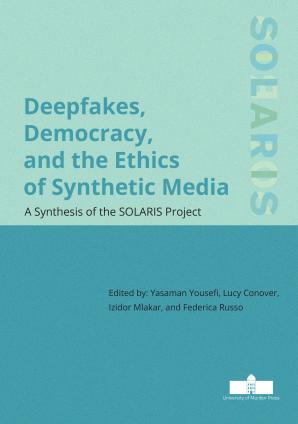
Yousefi, Y., Sánchez Galera, M. D., Tumminelli, A., Caltagirone, C., & Tonello, T. (2026). Governing Deepfakes: Legal Initiatives and Regulatory Gaps. In Y. Yousefi, L. Conover, I. Mlakar, & F. Russo (Eds.), Deepfakes, Democracy, and the Ethics of Synthetic Media: A Synthesis of the SOLARIS Project (pp. 141-158). University of Maribor Press. https://doi.org/10.18690/um.feri.2.2026.7