Democracy Distorted –Deepfakes as Political Weapons

Authors

Gjon Rakipi
Albanian Institute for International Studies (AIIS)
Yasaman Yousefi
University of Bologna
https://orcid.org/0000-0003-1483-2978
Calogero Caltagirone
University of LUMSA
https://orcid.org/0000-0002-8110-6995
Angelo Tumminelli
LUMSA University
https://orcid.org/0009-0005-4489-0222
Andrew McIntyre
University of Amsterdam
https://orcid.org/0000-0003-3683-7585
Aseniya Dimitrova
Brand Media Bulgaria

Synopsis

Affordable generative AI allows actors to produce and amplify deepfakes instantly, outpacing verification efforts. Drawing on Young’s (2011) distinction between isolated harms and structural injustice, this chapter identifies synthetic media as a structural threat to democracy that collapses the evidentiary foundations of public reason. We examine how deepfakes weaponize information ecosystems, using European and U.S. case studies to demonstrate their specific deployment against women and minority candidates. Methodologically, we analyse recent disinformation incidents through the lenses of epistemic injustice and deliberative democracy. We argue that deepfakes signal a deeper vulnerability where truth becomes malleable and public trust erodes. The chapter concludes that safeguarding democratic life requires not only legal and technical fixes, but a normative reorientation toward truthfulness and accountability.
Author Biographies

Gjon Rakipi, Albanian Institute for International Studies (AIIS)

Gjon Rakipi is a researcher and project manager at the Albanian Institute for International Studies (AIIS). His work focuses on the intersection of artificial intelligence, disinformation, and democratic governance, with a particular interest in how emerging technologies shape public trust and civic engagement. Within the EU-funded SOLARIS project, he contributes to research and stakeholder engagement activities addressing AI-driven disinformation and democratic resilience in Europe and the Balkans. Gjon holds degrees in molecular and cellular biology from LMU Munich and combines a scientific background with a growing focus on policy research, innovation, and digital transformation.

Tirana, Albania. E-mail: gjonrakipi@aiis-albania.org

Yasaman Yousefi, University of Bologna

Yasaman Yousefi is a researcher at DEXAI-Artificial Ethics in Rome and the University of Bologna in Italy. She collaborates as co-editor of the SOLARIS project and co-author of the introductory chapter. Her work focuses on ethical dimensions of artificial intelligence, synthetic media, and digital justice issues. She contributes to interdisciplinary research on positive AI technology applications and to developing ethical guidelines for responsible use of generative models in social contexts.

Bologna, Italy. E-mail: yasaman.yousefi@dexai.eu

Calogero Caltagirone, University of LUMSA

Calogero Caltagirone is full professor of Moral philosophy at Lumsa University and he researches in the field of moral philosophy and applied ethics. He studied philosophy and theology at the Antonianum University of Rome and at the Theological Faculty of Sicily, obtaining the related doctorates in philosophy and theology. He has carried out research activities in Italy and abroad, participating in academic projects on social justice, responsibility, and philosophical anthropology. He is the author of essays and articles published in scholarly journals and collaborates with university institutions to promote interdisciplinary dialogue between philosophy, the human sciences, and theology. His research focuses on public ethics and the philosophy of the person.

Rome, Italy. E-mail: c.caltagirone@lumsa.it

Angelo Tumminelli, LUMSA University

Angelo Tumminelli is Researcher in Moral Philosophy at the Department of Human Sciences of LUMSA University in Rome, where he teaches Anthropology and Ethics of Relationships and Ethics of Communication. He is also a visiting lecturer in Philosophy of Religion and History of Contemporary Philosophy at the “San Pietro” Theological Institute in Viterbo. Tumminelli earned his Ph.D. in Moral Philosophy from the Department of Philosophy at Sapienza University of Rome, where he conducted research on the concept of love in the thought of Max Scheler (winner of the 2018 SIFM Award). He has undertaken research stays in Germany and Israel and obtained a Licentiate in Jewish Studies and Jewish-Christian Relations from the Pontifical Gregorian University.

Rome, Italy. E-mail: a.tumminelli@lumsa.it

Andrew McIntyre, University of Amsterdam

Andrew McIntyre is a Postdoctoral Researcher at the University of Amsterdam’s Institute for Logic, Language and Computation. His research examines the socio-political implications of AI-generated media and sits at the intersection of media philosophy, philosophy of technology, and AI ethics. McIntyre holds a PhD in Film and Television Studies and has previously taught and conducted research at the University of Stirling, University of Glasgow, and Humboldt University of Berlin. His forthcoming monograph, Art and Authorship in the AI Spring, explores the emergence of modern AI art through the lens of media philosophy and the work of Vilém Flusser.

Amsterdam, the Netherlands. E-mail: a.mcintyre@uva.nl 

Aseniya Dimitrova, Brand Media Bulgaria

Aseniya Dimitrova has a Bachelor’s Degree in Political Sciences and Master’s Degrees in Political Management and Public Policies (New Bulgarian University) and in European Projects (Sofia University “St. Kliment Ohridski”). She is an experienced EU projects manager, working in the fields of communication, dissemination and stakeholder engagement. She works on, performs research and coordinates projects related to disinformation, media literacy, AI-generated disinformation, training, youth, EU cohesion policy, among others. She leads media campaigns promoting European values, integration and cross-border collaboration.

Sofia, Bulgaria. E-mail: a.dimitrova@economic.bg 

Downloads

Published

February 10, 2026

License

Creative Commons License

This work is licensed under a Creative Commons Attribution 4.0 International License.

How to Cite

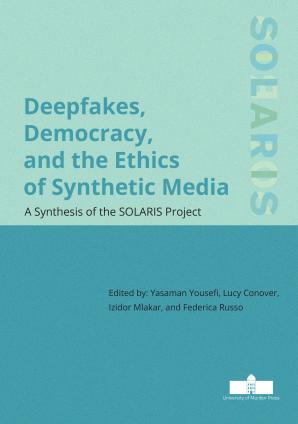
Rakipi, G., Yousefi, Y., Caltagirone, C., Tumminelli, A., McIntyre, A., & Dimitrova, A. (2026). Democracy Distorted –Deepfakes as Political Weapons. In Y. Yousefi, L. Conover, I. Mlakar, & F. Russo (Eds.), Deepfakes, Democracy, and the Ethics of Synthetic Media: A Synthesis of the SOLARIS Project (pp. 101-122). University of Maribor Press. https://doi.org/10.18690/um.feri.2.2026.5