The Spread of Deepfakes in Digital Networks

Authors

Tommaso Tonello
Utrecht University, Freudenthal Institute
Aseniya Dimitrova
Brand Media Bulgaria
Livio Fenga
University of Exeter
https://orcid.org/0000-0002-8185-2680
Luca Biazzo
Univerza v Brescii
https://orcid.org/0009-0001-9402-7284
Alessio Jacona
Agenzia Nazionale Stampa Associata

Synopsis

This chapter explores the spread of deepfakes through social media platforms (e.g. X, Facebook and TikTok). By studying real-world case studies, such as political deepfakes or celebrity impersonations, the chapter illustrates how synthetic media exploit online engagement dynamics to reach massive audiences quickly. It then reviews current methods used to detect and track deepfakes, especially early-warning systems monitoring content spread patterns to flag potential deepfakes in real time, as well as novel research instruments developed as part of the SOLARIS project. The chapter then presents the role of traditional media in debunking and contextualising deepfakes, reflecting upon the challenges that AI-generated disinformation poses to journalists and media professionals. In this context, insights from SOLARIS’ Use Case 2 are used to show how targeted interventions can slow the spread of harmful synthetic media. Finally, the chapter advocates for bottom-up AI education to frame digital citizens’ needs and to foster their ability to engage with online synthetic content.  
Author Biographies

Tommaso Tonello, Utrecht University, Freudenthal Institute

Tommaso Tonello is a History and Philosophy of Science (MRes) student at Utrecht University and a Comparative International Relations (MA) student at Ca’ Foscari University of Venice. Previously, he obtained a Master in Fine Arts (A. Pedrollo Conservatoire) and a Master in Economic Policy (Utrecht University). He is interested in AI education and training, soft law instruments in the context of AI regulation, and AI ethics and epistemology.

Utrecht, the Netherlands. E-mail: t.tonello@uu.nl

Aseniya Dimitrova, Brand Media Bulgaria

Aseniya Dimitrova has a Bachelor’s Degree in Political Sciences and Master’s Degrees in Political Management and Public Policies (New Bulgarian University) and in European Projects (Sofia University “St. Kliment Ohridski”). She is an experienced EU projects manager, working in the fields of communication, dissemination and stakeholder engagement. She works on, performs research and coordinates projects related to disinformation, media literacy, AI-generated disinformation, training, youth, EU cohesion policy, among others. She leads media campaigns promoting European values, integration and cross-border collaboration.

Sofia, Bulgaria. E-mail: a.dimitrova@economic.bg 

Livio Fenga, University of Exeter

Livio Fenga is a Senior Lecturer at the University of Exeter, serving as Module Convenor for the undergraduate Business Analytics in Practice and postgraduate Mathematics and Statistics for Business Analytics courses. His research expertise lies in Analytics, Machine Learning, and Data Science, with a focus on statistical models and AI algorithms for analyzing and predicting complex, non-linear, and chaotic phenomena. He is actively involved with the Center for Simulation Analysis and Modeling at the University of Exeter, where he conducts much of his research.

Exeter, United Kingdom. E-mail: l.fenga@exeter.ac.uk 

Luca Biazzo, Univerza v Brescii

Luca Biazzo is a third-year PhD candidate in Statistics and Data Science at the University of Brescia, holding a bachelor's and master's degree in Business Administration from the University of Rome Tor Vergata. His research focuses on time series analysis, forecasting, and anomaly detection, with particular emphasis on statistical models and machine learning algorithms for studying complex and dynamic phenomena. He actively collaborates with Professor Livio Fenga on research initiatives in these areas, as well as with Professor Maurizio Carpita on structural health monitoring of bridges.

Brescia, Italy. E-mail: luca.biazzo@unibs.it

Alessio Jacona, Agenzia Nazionale Stampa Associata

Alessio Jacona is a journalist, host, and moderator specializing in technology and innovation. He serves as the Curator of the Artificial Intelligence Observatory for Ansa.it and is a contributor to the Rai1 program, “Codice, la vita è digitale”. His work focuses on informing the wider public about how the adoption of new technologies (especially Artificial Intelligence) is fundamentally changing the meaning of what we do and who we are.

Rome, Italiy. E-mail: alessio.jacona@gmail.com

Downloads

Published

February 10, 2026

License

Creative Commons License

This work is licensed under a Creative Commons Attribution 4.0 International License.

How to Cite

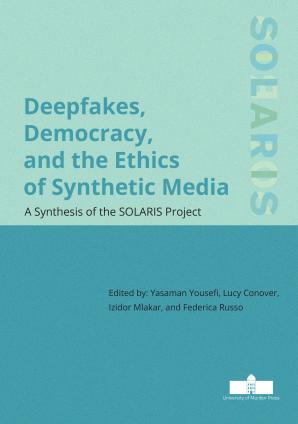
Tonello, T., Dimitrova, A., Fenga, L., Biazzo, L., & Jacona, A. (2026). The Spread of Deepfakes in Digital Networks. In Y. Yousefi, L. Conover, I. Mlakar, & F. Russo (Eds.), Deepfakes, Democracy, and the Ethics of Synthetic Media: A Synthesis of the SOLARIS Project (pp. 25-56). University of Maribor Press. https://doi.org/10.18690/um.feri.2.2026.2