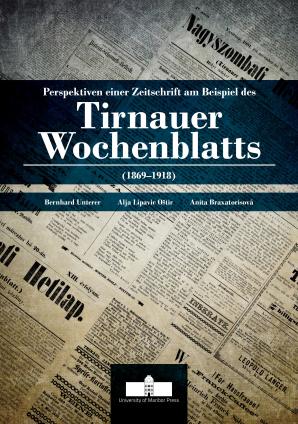
Perspektiven einer Zeitschrift am Beispiel des Tirnauer Wochenblatts (1869–1918)
Keywords:
newspaper Tirnauer Wochenblatt, educational discourses, family role models, gender-specific models, news, fractal analysis, ethnonyms, language policySynopsis
Perspectives of a Magazine Using the Example of the Tirnau Wochenblatt (1869 – 1918). The monograph offers various linguistic analyses of texts from the German-Hungarian newspaper Tirnauer Wochenblatt (1869–1918), with a focus on issues published shortly before the turn of the century. This temporal focus can be explained by language policy and the emergence of vernacular nationalism — both in Tyrnau, located in present-day Slovakia and the place of publication of the newspaper, and in the broader context of the monarchy, a time in which a strengthened bourgeoisie, as the target readership of the weekly, played a central social role. The Tirnauer Wochenblatt is examined from different perspectives: both in terms of its internal structure and its role in its contemporary context. The analyses place the newspaper partly within the context of the German-speaking minority and the German-language press in Slovakia at that time. The first part investigates the extent to which, and the ways in which, the newspaper reflects the educational discourses of the period, presents family role models, and addresses gender-specific models of roles in family and society. In this context, the monograph conducts a series of exemplary qualitative analyses that incorporate the perspective of the value system of bourgeois society. The second part analyzes a section of the newspaper that presents news from various regions of the monarchy. From the perspective of the development of text types in the press of the 19th century, the text type news report is examined, and the corpus of news items is subsequently analyzed quantitatively according to ten different parameters. This is followed by a comparison with texts from the same section that provide information from around the world, as well as a fractal analysis of the texts themselves. The investigation is further complemented by a comparison with texts of the same function from the same period in the Marburger Zeitung (1862–1945). The third part of the monograph presents a corpus-based analysis of ethnonyms that appeared in the Hungarian supplement of the same newspaper. These ethnonyms not only reflect the political tensions of that period in the monarchy but also linguistically shape a consistent system of values and interpretations that opens up a perspective on the national and cultural dynamics of the region and the time.
Downloads
Download data is not yet available.
References
Arató, E. (1983). A magyarországi nemzetiségek nemzeti ideológiája. Akadémia Kiadó.
Bańczerowski, J. (1996). A valóság nyelvi kategorizálásáról (Adalék a nyelvi szemantika elemzéséhez). Magyar nyelvőr 3, 64-70.
Bańczerowski, J. (1998). A nyelvhasználat elvi és etikai dimenziói. Magyar nyelvőr, 1, 15-20.
Bańczerowski, J. (2008). A világ nyelvi képe. A világkép mint a valóság metaképe a nyelvben és a nyelvhasználatban. Tinta Könyvkiadó.
Braxatoris, M., & Braxatorisová, A. (2023). Use of Computer and Corpus Tools in the Research of a 19th Century German-language Manuscript Book of Notes and Extracts. Jazykovedný časopis, 74 (1), 287-300
Braxatoris, M., V. Szabó, L., & Braxatorisová, A. (2024). Samuel Ferjenčík und sein Buch der Exzerpte und Notizen. Samuel Ferjenčík a jeho kniha výpiskov a poznámok. VEDA.
Bucher, H.-J. (1986). Pressekommunikation: Grundstrukturen einer öffentlichen Form der Kommunikation aus linguistischer Sicht. de Gruyter.
Burger, H., & Luginbühl, M. (2014). Mediensprache: Eine Einführung in Sprache und Kommunikationsfor-men der Massenmedien. de Gruyter.
Burger, H. (1990). Sprache der Massenmedien: Eine Einführung. de Gruyter.
Cingerová, N., Dulebová, I., & ŠTEFANČÍK (2021). Politická lingvistika. Ekonóm.
Csáky, M. (2010). Das Gedächtnis der Städte: Kulturelle Verflechtungen – Wien und die urbanen Milieus in Zentraleuropa. Böhlau.
Duchoňová, L. (2011). Trnavské plesy a bály v 19. storočí. Novinky z radnice, 22, 26-28.
Fenyves, K. (2012). When sexism meets racism: The 1920 numerus clausus law in Hungary. Hungari-an Cultural Studies, 5, 83-94. https://doi.org/10.5195/ahea.2012.35
Ferrante, J. (2016). Sociology: A global perspective (9. Aufl.). Wadsworth/Cengage Learning.
Frevert, U. (1988). Einleitung. In Ders. (Hrsg.), Bürgerinnen und Bürger: Geschlechterverhältnisse im 19. Jahrhundert, (Kritische Studien zur Geschichtswissenschaft; Band 77, S. 11-16). Vanden-hoeck & Ruprecht.
Garabík, R., & Karčová, A. (2025). Prídavné mená v slovenčine. Štúdie a štatistiky na báze korpusov slovenčiny. VEDA.
Gestrich, A. (2010). Geschichte der Familie im 19. und 20. Jahrhundert, (2. Aufl., Enzyklopädie deut-scher Geschichte, Band 50). R. Oldenbourg Verlag.
Haslinger, P. (2008). Sprachenpolitik, Sprachendynamik und imperiale Herrschaft in der Habsbur-germonarchie 1740 – 1914. Zeitschrift für Ostmitteleuropa-Forschung, 1, 81-111.
Hettling, M., & Hoffmann, S. (2000). Einleitung: Zur Historisierung bürgerlicher Werte. In Dies. (Hrsg.), Der bürgerliche Wertehimmel: Innenansichten des 19. Jahrhunderts, (S. 7-21). Vanden-hoeck & Ruprecht.
Jockers, M. L. (2013). Macroanalysis: Digital Methods & Literary History. University of Illinois Press.
Jurčová, S. (2020). Čas bálov, plesov, karnevalov. Novinky z radnice. Život a kultúra Trnavy, 31, 8-12.
Jurčová, S. (2022). Zabudnuté tradície? Majálesy, juniálesy a Benátska noc v Trnave. Novinky z radnice. Život a kultúra Trnavy, 33, 12-17.
Keane, A. H. (1882). Im Fernen Osten, Reisen des Grafen Bela Szechenyi in den Jahren 1877 – 1880. Nature, 27, 170-172.
Kijko, J. (2016). Fraktalität in deutschen und ukrainischen informationsbetonten Textsorten. Ger-manica Wratislaviensia, 141, 234-244.
Kilgarriff, A., Rychlý, P., Smrž, P., & Tugwell, P. (2004). The Sketch Engine. Proceedings of the 11th EURALEX International Congress, 105-116.
Kilgarriff, A., Baisa, V., Bušta, J., Jakubíček, M., Kovář, V., Michelfeit, J., Rychlý, P., & Suchomel. V. (2014). The Sketch Engine: ten years on. Lexicography, 1, 7-36.
Kocka, J. (1995). Das europäische Muster und der deutsche Fall. In Ders. (Hrsg.), Bürgertum im 19.Jahrhundert. Deutschland im europäischen Vergleich, (2. Band, S. 9-84). Dtv Verlag.
Kocka, J. (2011). Arbeiten an der Geschichte. Gesellschaftlicher Wandel im 19. und 20. Jahrhundert. (Kriti-sche Studien zur Geschichtswissenschaft; Band 200). Vandenhoeck & Ruprecht.
Kosev, K. (1980). Die Politik Deutschlands in der Ostfrage in den 60er und 70er Jahren des 19. Jahrhunderts und die Befreiung Bulgariens. In Schaller. (Hrsg.), Sprache und Politik Die Bal-kansprachen in Vergangenheit und Gegenwart. (S. 227-243). Verlag Otto Sagner.
Králik, Ľ. (2015). Stručný etymologický slovník slovenčiny. VEDA.
Kramberger, P. (2005). Nemško časopisje v Mariboru v 19. stoletju. Kronika, 53, 37-52.
Krautwald, B. (2021). Bürgerliche Frauenbilder im 19. Jahrhundert. Die Zeitschrift »Der Bazar« als Ver-handlungsforum weiblichen Selbstverständnisses. (Historische Geschlechterforschung, Band 4). Transcript Verlag.
La Roche, W. von. (1984). Einführung in den praktischen Journalismus: Mit genauer Beschreibung aller Ausbildungswege. Deutschland. Österreich. Schweiz. Econ.
Liedtke, M. (1977). Pestalozzi-Plädoyer für die Methode. Zeitschrift für Pädagogik, 14 (Beiheft), 249-258.
Lipavic Oštir, A. (2025a). Marburger Deutsch aus der heutigen Perspektive. Linguistic Minorities in Europe online. (im Druck)
Lipavic Oštir, A. (2025b) Von Nah und Fern im 'Tirnauer Wochenblatt‘ ab 1880. Aussiger Beiträge, 19 (Supplement), 103-122. https://ab.ff.ujep.cz/de/jahrgang-19-2025-supplement
Lüger, H.-H. (1995). Pressesprache. Niemeyer.
Meier, J. (2016). Untersuchungen in deutschsprachiger Periodika in Kaschau / Košice. In A. Greule, & P. Rössler (Hrsg.), Sprachbrücken: Aktuelle Forschungen zur deutschen Sprache und Literatur in der Slowakei (S. 87-98). Weidler.
Moretti, F. (2013). Distant Reading. Verso.
Münch, P. (1984). Einleitung. »Bürgerliche Tugenden«. In Ders. (Hrsg.), Ordnung, Fleiß und Sparsam-keit Texte und Dokumente zur Entstehung der »bürgerlichen Tugenden«, (S. 9-22). Dtv Verlag.
Mutschlechner, M. (2025a, 15. November). Die Slowaken in der Habsburgermonarchie. Die Welt der Habsburger. https://ww1.habsburger.net/de/kapitel/die-slowaken-der-habsburgermonarchie
Mutschlechner, M. (2025b, 15. November). Spätes Erwachen: Die Entstehung der modernen slowakischen Nation. Die Welt der Habsburger. https://ww1.habsburger.net/de/kapitel/die-slowaken-der-habsburgermonarchie
Neumann, T. (2002). Einführung. In Ders. (Hrsg.), Quellen zur Geschichte Thüringens. Pädagogik im 18. und 19. Jahrhundert, (S. 9-27). Sömmerda GmbH.
Osterhammel, J. (2010). Die Verwandlung der Welt. Eine Geschichte des 19. Jahrhunderts. (5. Aufl.). C. H. Beck.
Potemra, M. (1963). Bibliografia inorečových novín a časopisov na Slovensku do roku 1918. Matica slovenská.
Püschel, U. (1991). Journalistische Textsorten im 19. Jahrhundert. In R. Wimmer (Hrsg.), Das 19. Jahrhundert: Sprachgeschichtliche Wurzeln des heutigen Deutsch (S. 428-447). de Gruyter.
Radtke, P. (2006). Das Bild behinderter Menschen in den Medien. Spektrum Freizeit, 2(2006), 120-131.
Rosenbaum, H. (1996). Formen der Familie. Untersuchungen zum Zusammenhang von Familienverhältnissen, Sozialstruktur und sozialem Wandel in der deutschen Gesellschaft des 19. Jahrhunderts. Suhrkamp.
Schuppener, G. (2017). Das Tirnauer Wochenblatt – Stand der Erschließung und weitere Perspekti-ven. Symbole Cassovienses. Kaschauer Beiträge zur Sprache und Kultur. Košické listy o jazyku a kultúre, (1), 39-49.
Schuppener, G. (2023). Das Verhältnis von Deutsch und Ungarisch im Tirnauer Wochenblatt. Slo-wakische Zeitschrift für Germanistik, 15 (1), 140-146.
Schuppener, G. (2024). Kulturelles im Tirnauer Wochenblatt. Slovenská literatúra, 71(4), 380-389.
Schuppener, G. (2025a). Mehrsprachigkeit und Sprachenlernen im ‚Tirnauer Wochenblatt‘. Aussiger Beiträge, 19 (Supplement), 123-137. https://ab.ff.ujep.cz/de/jahrgang-19-2025-supplement
Schuppener, G. (2025b) Das Tirnauer Wochenblatt. Überlieferung, Entwicklung und sprachliche Situation. Praesens Verlag.
UNESCO. (2002). Universal declaration on cultural diversity. United Nations Educational, Scientific and Cultural Organization.
Unterer, B. (2025). Formale, linguistische und rhetorische Elemente in der Werbesprache des ‚Tir-nauer Wochenblatts‘. Aussiger Beiträge, 19 (Supplement), 139-154. https://ab.ff.ujep.cz/de/jahrgang-19-2025-supplement
Downloads
Published
December 9, 2025
Categories
Copyright (c) 2025 University of Maribor, University of Maribor Press
License

This work is licensed under a Creative Commons Attribution-NonCommercial-ShareAlike 4.0 International License.
Details about this monograph
THEMA Subject Codes (93)
CB
ISBN-13 (15)
978-961-299-091-6
COBISS.SI ID (00)
Date of first publication (11)
2025-12-09
How to Cite
Unterer, B., Lipavic Oštir, A., & Braxatorisová, A. (2025). Perspektiven einer Zeitschrift am Beispiel des Tirnauer Wochenblatts (1869–1918). University of Maribor Press. https://doi.org/10.18690/um.ff.10.2025