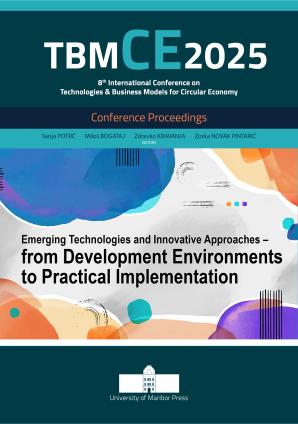
8th International Conference on Technologies & Business Models for Circular Economy: Conference Proceedings
Keywords:
circular economy, sustainable development, processes and technologies, circular business models, and developmentSynopsis
The 8th international scientific, professional and development conference Technologies & Business Models for Circular Economy (TBMCE) was organised by the Faculty of Chemistry and Chemical Engineering, University of Maribor, in collaboration with the Strategic Research and Innovation Partnership – Networks for the Transition into Circular Economy (SRIP – Circular Economy), managed by the Chamber of Commerce and Industry of Štajerska. The event took place from 3 to 5 September 2025 at the Grand Hotel Bernardin in Portorož, Slovenia. The conference addressed key research and development areas related to the transition to a circular economy, including improvements in energy efficiency, process electrification, and the use of renewable and low-carbon energy sources. Particular emphasis was placed on the optimisation of resource use, recovery of critical materials from waste, and the conversion of residues into high value-added products. Approaches to sustainable water resource management, circular CO₂ utilisation, and the development of green processes and technologies were also discussed. In addition, aspects of digitalisation, standardisation, and the development of innovative circular business models were considered as key enabling mechanisms for the transition to a circular economy.
Chapters
-
Alkali-activated Fly Ash Composites with Canine-fibre Reinforcement
-
Optimisation of Fly Ash Pretreatment for Mechanical Strength and Radioactive Safety in Microwave-irradiated Alkali-Activated MaterialsPreliminary Results
-
Energy-Efficient CoatingsThe Role of Heat-Reflecting Pigmentss
-
Utilisation of Industrial Red Gypsum for Sustainable Cementitious and Geopolymer Composites
-
The Influence of Processed Steel Slag Additive on Brick-Making Clay
-
Assessment of the Technological Feasibility and Economic Viability of Residue Valorisation in Apple Processing
-
Virtual Technology For Teaching About Drinking Water Preparation And Wastewater Treatment
-
Mineral CO₂ Sequestration in Industrial Waste Materials: A Comparative Study Using FTIR, TGA and Calcimetry
-
Fibre-Reinforced Cement as a Source of Microplastics and Their Post-Release Behaviour
-
Prediction of Hydrophobic Properties in Biopolymer-Based Coatings via Formulation Data Modelling
-
A Business Model Framework for Scaling Bioleaching TechnologyFrom Laboratory to Semi-Industrial Applications for CRM Recovery from E-Waste PCBs
Downloads
Download data is not yet available.
References
Downloads
Published
April 21, 2026
Categories
Copyright (c) 2026 University of Maribor
License

This work is licensed under a Creative Commons Attribution-NonCommercial-NoDerivatives 4.0 International License.
Details about the available publication format: E-book (pdf)
E-book (pdf)
ISBN-13 (15)
9789612991302
COBISS.SI ID (00)
THEMA Subject Codes (93)
KJD, TGB
Date of first publication in original language (20)
2026-04-21
Details about the available publication format: PDF
PDF
Physical Dimensions
How to Cite
Potrč, S., Miloš Bogataj, M. B., Zdravko Kravanja, Z. K., & Novak Pintarič, Z. (Eds.). (2026). 8th International Conference on Technologies & Business Models for Circular Economy: Conference Proceedings (Vols. 8.). University of Maribor Press. https://doi.org/10.18690/um.fkkt.1.2026