Artificial Intelligence Transformation in Higher Education: Student Literacy, Ethical Perceptions, and Institutional Governance

Authors

András Szeberényi
Budapest Metropolitan University, Institute of Marketing and Communication
https://orcid.org/0000-0002-1387-0350
Dorottya Edina Kozma
University of Pannonia, Faculty of Business
https://orcid.org/0000-0002-4948-8815
Róbert Balku
Budapest Metropolitan University, Faculty of Business, Communication and Tourism
https://orcid.org/0009-0000-6684-495X
Beáta Pajor
Corvinus University of Budapest, Institute of Strategy and Management

Synopsis

The rapid integration of Artificial Intelligence (AI) into higher education poses significant challenges for institutional management and sustainable governance. This paper examines the ongoing AI transformation by exploring three primary dimensions: student AI literacy, ethical perceptions of academic integrity, and the psychological impacts of technology adoption. Employing a Systematic Literature Review (SLR) that strictly follows PRISMA guidelines, this study systematically reviews 42 recent peer-reviewed articles from the Scopus database, extracts 12 core studies, and maps the multifaceted effects of generative tools such as ChatGPT, Copilot, and Gemini. The findings reveal a critical “illusion of competence”, where students’ technical proficiency significantly outpaces their critical evaluation skills. The lack of clear institutional directives exacerbates unintentional academic over-reliance and blurs ethical boundaries. The review highlights a rising phenomenon of algorithmic anxiety, primarily driven by the deployment of unreliable AI content-detection systems that undermine the student-educator trust dynamic. This research also underscores the necessity for universities to transition from restrictive policies to comprehensive educational frameworks, ensuring the responsible use of generative technologies while safeguarding students’ cognitive development and mental well-being.
Author Biographies

András Szeberényi, Budapest Metropolitan University, Institute of Marketing and Communication

Dr. habil. András Szeberényi is a Habilitated College Professor and the Head of the Marketing Department at Budapest Metropolitan University, Institute of Marketing and Communication. He holds a habilitation in Economics and Organizational Sciences. He has been researching various dimensions of sustainability since 2012, with a strong focus on regional and generational studies. Since 2022, his research has expanded to examine the socio-psychological effects of climate anxiety and the integration of artificial intelligence in these domains. He possesses significant expertise in higher education, training, and scientific research.

Budapest, Hungary. E-mail: szeberenyi.andras@sze.hu

Dorottya Edina Kozma, University of Pannonia, Faculty of Business

Kozma Dorottya Edina earned her PhD with an empirical study on sustainable development. Her main research areas include the examination of sustainable development within the European Union, the development of composite indicators based on circular economy and climate change metrics, and national regulatory frameworks related to the legal implementation of ESG in the V4 countries.

Veszprém, Hungary. E-mail: kozma.dorottya.edina@gtk.uni-pannon.hu

Róbert Balku, Budapest Metropolitan University, Faculty of Business, Communication and Tourism

Róbert Balku is an MBA student at the Budapest Metropolitan University, Institute of Marketing and Communication, Department of Marketing. He has been working in information technology operations and development for two decades. Concurrently, he brings valuable industry experience from his role at Oracle Global Services Hungary Kft. His primary professional interests include the performance analysis and troubleshooting of IT systems and databases, identifying bottlenecks, query optimization, and improving the efficiency of cloud-based operations.

Budapest, Hungary. E-mail: robert.balku@gmail.com

Beáta Pajor, Corvinus University of Budapest, Institute of Strategy and Management

Beáta Pajor has over 12 years of experience in project management, leadership, and coaching. She is currently a PhD candidate at Corvinus University of Budapest. Her primary research areas include workplace well-being, motivation, and employee engagement, as well as the organizational and individual factors influencing these outcomes. In particular, she examines the impact of core job conditions, leadership roles, organizational culture, and individual differences on employee well-being. A new direction in her research focuses on sustained overperformance and its individual- and organizational-level consequences.

Budapest, Hungary. E-mail: beata.pajor@stud.uni-corvinus.hu  

Downloads

Published

July 3, 2026

License

Creative Commons License

This work is licensed under a Creative Commons Attribution 4.0 International License.

How to Cite

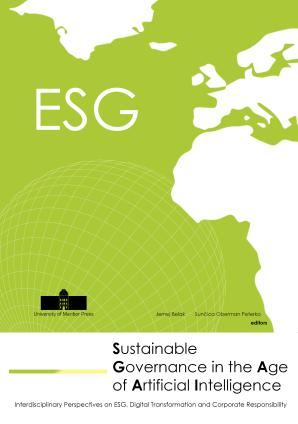
Szeberényi, A., Kozma, D. E., Balku, R., & Pajor, B. (2026). Artificial Intelligence Transformation in Higher Education: Student Literacy, Ethical Perceptions, and Institutional Governance. In J. Belak & S. Oberman Peterka (Eds.), Sustainable Governance in the Age of Artificial Intelligence: Interdisciplinary Perspectives on ESG, Digital Transformation and Corporate Responsibility (pp. 615-630). University of Maribor Press. https://doi.org/10.18690/um.epf.7.2026.32