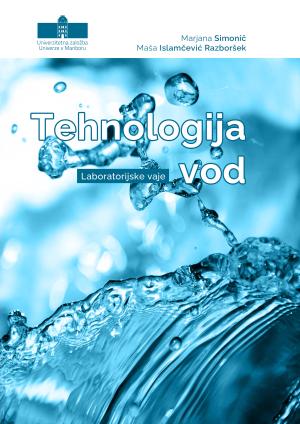
Tehnologija vod: Laboratorijske vaje
Ključne besede:
tehnologija voda, kakovost vode, laboratorijske analize, fizikalno-kemijski parametri, trdota vode, prosta ogljikova kislina, karbonatno ravnotežje, JAR test, reverzna osmozaKratka vsebina
Publikacija predstavlja zbirko laboratorijskih vaj s področja tehnologije voda, namenjenih razumevanju osnovnih fizikalno-kemijskih lastnosti vode in metod njihovega določanja. Vključuje analize, kot so določanje pH, prevodnosti, motnosti, trdote, določanje proste ogljikove kisline in karbonatnega ravnotežja. Predstavljena sta JAR test in reverzna osmoza. Poseben poudarek je na praktičnem delu, pravilni uporabi laboratorijske opreme in interpretaciji rezultatov. Publikacija povezuje teoretično znanje s praktičnimi primeri ter spodbuja razumevanje pomena kakovosti vode v okoljskem in inženirskem kontekstu. Navodilom so dodana tudi navodila za varno delo v laboratoriju, pregled simbolov nevarnih snovi in napotki za prvo pomoč. Namenjena so predvsem študentom tehničnih in naravoslovnih smeri kot podpora pri laboratorijskem delu in razumevanju procesov v vodnem okolju.
Prenosi
Podatki o prenosih še niso na voljo.
Literatura
[1] G. Urbančič and M. Toman Jožef, Varstvo celinskih voda. Ljubljan: Študentska založba, 2003.
[2] WHO, “Fourth edition incorporating the first and second addenda Guidelines for drinking-water quality,” Geneva, Switzerland, 2011.
[3] S. Larance, J. Wang, M. A. Delavar, and M. Fahs, “Assessing Water Temperature and Dissolved Oxygen and Their Potential Effects on Aquatic Ecosystem Using a SARIMA Model,” Environments - MDPI, vol. 12, no. 1, Jan. 2025, doi: 10.3390/environments12010025.
[4] J. Koue, “Assessing the impact of climate change on dissolved oxygen using a flow field ecosystem model that takes into account the anaerobic and aerobic environment of bottom sediments,” Acta Geochimica, vol. 44, no. 1, pp. 11–22, Feb. 2025, doi: 10.1007/s11631-024-00711-4.
[5] A. Boretti and L. Rosa, “Reassessing the projections of the World Water Development Report,” NPJ Clean Water, vol. 2, no. 1, Dec. 2019, doi: 10.1038/s41545-019-0039-9.
[6] D. V. . Chapman, Water quality assessments : a guide to the use of biota, sediments, and water in environmental monitoring. CRC Press, 2021.
[7] C. N. . Sawyer, P. L. . McCarty, and G. F. . Parkin, Chemistry for environmental engineering and science. McGraw-Hill, 2007.
[8] Jamie. Bartram and Richard. Ballance, Water quality monitoring : a practical guide to the design and implementation of freshwater quality studies and monitoring programmes. E & FN Spon, 1996.
[9] H. W. Paerl and T. G. Otten, “Harmful Cyanobacterial Blooms: Causes, Consequences, and Controls,” Microb. Ecol., vol. 65, no. 4, pp. 995–1010, May 2013, doi: 10.1007/s00248-012-0159-y.
[10] F. Freeling et al., “Occurrence and potential environmental risk of surfactants and their transformation products discharged by wastewater treatment plants,” Science of the Total Environment, vol. 681, pp. 475–487, Sep. 2019, doi: 10.1016/j.scitotenv.2019.04.445.
[11] R. G. . Wetzel, Limnology : lake and river ecosystems. Academic Press, 2001.
[12] S. Birk et al., “Three hundred ways to assess Europe’s surface waters: An almost complete overview of biological methods to implement the Water Framework Directive,” Ecol. Indic., vol. 18, pp. 31–41, 2012, doi: 10.1016/j.ecolind.2011.10.009.
[13] I. Douterelo, R. L. Sharpe, S. Husband, K. E. Fish, and J. B. Boxall, “Understanding microbial ecology to improve management of drinking water distribution systems,” Wiley Interdisciplinary Reviews: Water, vol. 6, no. 1, Jan. 2019, doi: 10.1002/WAT2.1325.
[14] Meena. Palaniappan, Clearing the waters : a focus on water quality solutions. Pacific Institute ; United Nations Environment Programme, Division of Environmental Policy Implementation, 2010.
[15] K. Tarman, Ekologija: učbenik za strokovne in tehniške gimnazije. DZS, 2007.
[16] More people, more food, worse water? : a global review of water pollution from agriculture/ edited by Javier Mateo-Sagasta, Sara Marjani Zadeh, Hugh Turral. International Water Management Institute, 2018.
[17] K. Žitnik, “Tehnološki pristopi k čiščenju vode z vidika odstranjevanja PFAS-diplomsko delo,” 2025.
[18] C. Lassen et al., Title: Microplastics-Occurrence, effects and sources of releases to the environment in Denmark. [Online]. Available: www.eng.mst.dk
[19] J. A. Silva, “Wastewater Treatment and Reuse for Sustainable Water Resources Management: A Systematic Literature Review,” Jul. 01, 2023, Multidisciplinary Digital Publishing Institute (MDPI). doi: 10.3390/su151410940.
[20] N. Samec, Osnove okoljskega inženirstva. Maribor: Tiskarna tehniških fakultet, 1999.
[21] “EN ISO 5667-6:2016+A11:2020. Water quality — Sampling — Part 6: Guidance on sampling of rivers and streams.”.
[22] Karl. Höll, Wasser : Unters., Beurteilung, Aufbereitung, Chemie, Bakteriologie, Virologie, Biologie. De Gruyter, 1979.
Prenosi
Izdano
23 aprila 2026
Kategorije
Avtorske pravice (c) 2026 Univerza v Mariboru, Univerzitetna založba
Licenca

To delo je licencirano pod Creative Commons Priznanje avtorstva-Nekomercialno-Brez predelav 4.0 mednarodno licenco.
Podrobnosti o monografski publikaciji
ISBN-13 (15)
978-961-299-140-1
COBISS.SI ID (00)
THEMA Subject Codes (93)
T, Q
Date of first publication in original language (20)
23.04.2026
Kako citirati
Simonič, M., & Islamčević Razboršek, M. (2026). Tehnologija vod: Laboratorijske vaje. Univerzitetna založba Univerze v Mariboru. https://doi.org/10.18690/um.fkkt.4.2026