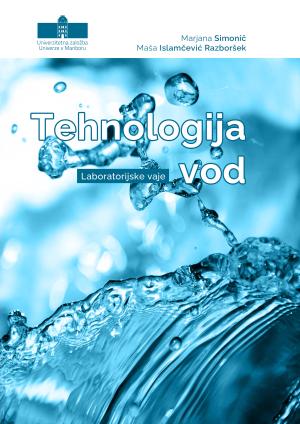
Tehnologija vod: Laboratorijske vaje
Keywords:
water technology, water quality, laboratory analyses, physicochemical parameters, water hardness, free carbon dioxide, carbonate equilibrium, JAR test, reverse osmosisSynopsis
Water Technology: Laboratory Exercises. The publication presents a collection of laboratory exercises in water technology, aimed at understanding the basic physicochemical properties of water and the methods used to determine them. It includes analyses such as pH, conductivity, turbidity, hardness, free carbon dioxide, and carbonate equilibrium. The Jar test and reverse osmosis are also covered. Special emphasis is placed on practical work, correct use of laboratory equipment, and interpretation of results. The publication integrates theoretical knowledge with practical examples and promotes understanding of the importance of water quality in environmental and engineering contexts. It also provides guidelines for safe laboratory work, an overview of hazardous substance symbols, and basic first aid instructions. It is primarily intended for students in technical and natural sciences as support for laboratory work and for understanding processes in aquatic environments.
Downloads
Download data is not yet available.
References
[1] G. Urbančič and M. Toman Jožef, Varstvo celinskih voda. Ljubljan: Študentska založba, 2003.
[2] WHO, “Fourth edition incorporating the first and second addenda Guidelines for drinking-water quality,” Geneva, Switzerland, 2011.
[3] S. Larance, J. Wang, M. A. Delavar, and M. Fahs, “Assessing Water Temperature and Dissolved Oxygen and Their Potential Effects on Aquatic Ecosystem Using a SARIMA Model,” Environments - MDPI, vol. 12, no. 1, Jan. 2025, doi: 10.3390/environments12010025.
[4] J. Koue, “Assessing the impact of climate change on dissolved oxygen using a flow field ecosystem model that takes into account the anaerobic and aerobic environment of bottom sediments,” Acta Geochimica, vol. 44, no. 1, pp. 11–22, Feb. 2025, doi: 10.1007/s11631-024-00711-4.
[5] A. Boretti and L. Rosa, “Reassessing the projections of the World Water Development Report,” NPJ Clean Water, vol. 2, no. 1, Dec. 2019, doi: 10.1038/s41545-019-0039-9.
[6] D. V. . Chapman, Water quality assessments : a guide to the use of biota, sediments, and water in environmental monitoring. CRC Press, 2021.
[7] C. N. . Sawyer, P. L. . McCarty, and G. F. . Parkin, Chemistry for environmental engineering and science. McGraw-Hill, 2007.
[8] Jamie. Bartram and Richard. Ballance, Water quality monitoring : a practical guide to the design and implementation of freshwater quality studies and monitoring programmes. E & FN Spon, 1996.
[9] H. W. Paerl and T. G. Otten, “Harmful Cyanobacterial Blooms: Causes, Consequences, and Controls,” Microb. Ecol., vol. 65, no. 4, pp. 995–1010, May 2013, doi: 10.1007/s00248-012-0159-y.
[10] F. Freeling et al., “Occurrence and potential environmental risk of surfactants and their transformation products discharged by wastewater treatment plants,” Science of the Total Environment, vol. 681, pp. 475–487, Sep. 2019, doi: 10.1016/j.scitotenv.2019.04.445.
[11] R. G. . Wetzel, Limnology : lake and river ecosystems. Academic Press, 2001.
[12] S. Birk et al., “Three hundred ways to assess Europe’s surface waters: An almost complete overview of biological methods to implement the Water Framework Directive,” Ecol. Indic., vol. 18, pp. 31–41, 2012, doi: 10.1016/j.ecolind.2011.10.009.
[13] I. Douterelo, R. L. Sharpe, S. Husband, K. E. Fish, and J. B. Boxall, “Understanding microbial ecology to improve management of drinking water distribution systems,” Wiley Interdisciplinary Reviews: Water, vol. 6, no. 1, Jan. 2019, doi: 10.1002/WAT2.1325.
[14] Meena. Palaniappan, Clearing the waters : a focus on water quality solutions. Pacific Institute ; United Nations Environment Programme, Division of Environmental Policy Implementation, 2010.
[15] K. Tarman, Ekologija: učbenik za strokovne in tehniške gimnazije. DZS, 2007.
[16] More people, more food, worse water? : a global review of water pollution from agriculture/ edited by Javier Mateo-Sagasta, Sara Marjani Zadeh, Hugh Turral. International Water Management Institute, 2018.
[17] K. Žitnik, “Tehnološki pristopi k čiščenju vode z vidika odstranjevanja PFAS-diplomsko delo,” 2025.
[18] C. Lassen et al., Title: Microplastics-Occurrence, effects and sources of releases to the environment in Denmark. [Online]. Available: www.eng.mst.dk
[19] J. A. Silva, “Wastewater Treatment and Reuse for Sustainable Water Resources Management: A Systematic Literature Review,” Jul. 01, 2023, Multidisciplinary Digital Publishing Institute (MDPI). doi: 10.3390/su151410940.
[20] N. Samec, Osnove okoljskega inženirstva. Maribor: Tiskarna tehniških fakultet, 1999.
[21] “EN ISO 5667-6:2016+A11:2020. Water quality — Sampling — Part 6: Guidance on sampling of rivers and streams.”.
[22] Karl. Höll, Wasser : Unters., Beurteilung, Aufbereitung, Chemie, Bakteriologie, Virologie, Biologie. De Gruyter, 1979.
Downloads
Published
April 23, 2026
Categories
Copyright (c) 2026 University of Maribor, University of Maribor Press
License

This work is licensed under a Creative Commons Attribution-NonCommercial-NoDerivatives 4.0 International License.
Details about this monograph
ISBN-13 (15)
978-961-299-140-1
COBISS.SI ID (00)
THEMA Subject Codes (93)
T, Q
Date of first publication in original language (20)
2026-04-23
How to Cite
Simonič, M., & Islamčević Razboršek, M. (2026). Tehnologija vod: Laboratorijske vaje. University of Maribor Press. https://doi.org/10.18690/um.fkkt.4.2026