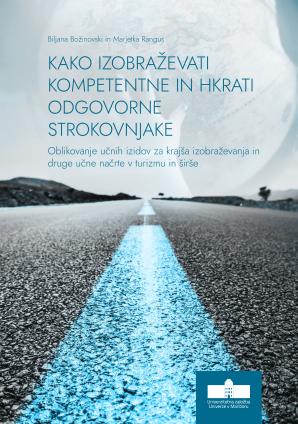
Kako izobraževati kompetentne in hkrati odgovorne strokovnjake: oblikovanje učnih izidov za krajša izobraževanja in druge učne načrte v turizmu in širše
Keywords:
short courses and training programmes, micro-credentials, learning outcomes, philosophical practitioner, sustainability competences, balanced curriculumSynopsis
Educating Competent and Responsible Professionals: Designing Learning Outcomes for Short Courses and Other Programmes in Tourism and Beyond. This handbook provides practical guidance on designing learning outcomes for short courses developed collaboratively by higher education institutions and the tourism sector. It promotes a balanced curriculum integrating knowledge, practical skills and critical thinking. While focusing on tourism, its approach can also be applied to degree programmes and other fields. The handbook draws on the University of Maribor’s guidelines and internal quality management processes for short courses and training, relevant literature, and an analysis of learning outcomes from selected tourism courses through the lens of the philosophical practitioner. It also incorporates good teaching practices presented at the international conference Transforming Tourism and Hospitality through Education (TEDU25), methodological guidance on writing learning outcomes, and European frameworks for developing sustainability competences.
Downloads
Download data is not yet available.
References
Ahmad, N., Toro-Troconis, M., Ibahrine, M., Armour, R., Tait, V., Reedy, K., ... & Inzolia, Y. (2023). CoDesignS education for sustainable development: A framework for embedding education for sustainable development in curriculum design. Sustainability, 15(23), 16460. https://doi.org/10.3390/su152316460
Anderson, L. W., & Krathwohl, D. R. (2001). A taxonomy for learning, teaching, and assessing: A revision of Bloom's taxonomy of educational objectives: complete edition. Addison Wesley Longman, Inc.
Barnett, R. (2004). Learning for an unknown future. Higher education Research & development, 23(3), 247-260. https://doi.org/10.1080/0729436042000235382
Biggs, J. & Tang, C. (2011). Teaching for quality learning at university: What the student does (3rd edition). Maidenhead: Socienty for Research into Higher Education & Open University Press / McGraw-Hill Education. https://www.sarahnilsson.org/app/download/965826150/2_49657968-Teaching-for-Quality-Learning-at-University.pdf
Bloom, B. S., Engelhart, M. D., Furst, E. J., Hill, W. H., & Krathwohl, D. R. (1956). Taxonomy of educational objectives: The classification of educational goals. Handbook 1: Cognitive domain (pp. 1103-1133). New York: Longman.
Cooper, C. (2006). Knowledge Management and Tourism. Annals of Tourism Research, 33(1), 47–64. https://doi.org/10.1016/j.annals.2005.04.005
Cooper, C. (2022). Essentials of Tourism (4th ed.). SAGE Publications.
Cosgrove, J. & Cachia, R. (2025). DigComp 3.0 – European Digital Competence Framework, fifth edition. Publications Office of the European Union. https://data.europa.eu/doi/10.2760/0001149
Dewey, J. (1917/1996). Learning to earn: the place of vocational education in a comprehensive scheme of public education. In J.A. Boydston (Ed.), The Collected Works of John Dewey, 1882-1953 (p. 144). Southern Illinois University Press.
Dredge, D., Benckendorff, P., Day, M., Gross, M. J., Walo, M., Weeks, P. and Whitelaw, P. (2012). The philosophic practitioner and the curriculum space. Annals of Tourism Research, 39(4), 2154-2176. https://doi.org/10.1016/j.annals.2012.07.017
Edelheim, J., Joppe, M. and Flaherty, J. (Eds.). (2022). Teaching tourism: Innovative, values-based learning experiences for transformative practices. Edward Elgar Publishing. DOI: 10.4337/9781800374560
European Commission (2015). ECTS Users’ Guide (2015 edition). Publications Office of the European Union. https://op.europa.eu/en/publication-detail/-/publication/da7467e6-8450-11e5-b8b7-01aa75ed71a1
Evropska komisija (n.d.-a). Spretnosti in kompetence. ESCO – Evropska klasifikacija spretnosti, kompetenc, kvalifikacij in poklicev. https://esco.ec.europa.eu/sl/classification/skill_main
Evropska komisija (n.d.-b). Evropski sistem prenašanja in zbiranja kreditnih točk (ECTS). Evropska komisija. https://education.ec.europa.eu/sl/education-levels/higher-education/inclusive-and-connected-higher-education/european-credit-transfer-and-accumulation-system
Evropska komisija. (2022). GreenComp: Evropski okvir kompetenc za trajnostnost (G. Bianchi, U. Pisiotis & M. Cabrera, avtorji; Y. Punie & M. Bacigalupo, ur.). Urad za publikacije Evropske unije. https://www.zrss.si/pdf/greencomp.pdf
Evropska komisija (2006). Ključne kompetence za vseživljenjsko učenje: Evropski referenčni okvir (Priporočilo 2006/962/ES). Uradni list Evropske unije. https://op.europa.eu/sl/publication-detail/-/publication/5719a044-b659-46de-b58b-606bc5b084c1/language-sl
Evropski parlament in Svet Evropske unije. (2006). Priporočilo Evropskega parlamenta in Sveta z dne 18. decembra 2006 o ključnih kompetencah za vseživljenjsko učenje (2006/962/ES). Uradni list Evropske unije, L 394, 10–18. https://eur-lex.europa.eu/legal-content/SL/TXT/?uri=uriserv:OJ.L_.2006.394.01.0010.01.SLV
Flogie, A. (2023). Bloomova digitalna taksonomija. Inovativna pedagogika 5.0. https://inovativna-sola.si/glagoli-po-bloomu/
Freire, P. (1992/2007). Pedagogy of hope: Reliving Pedagogy of the oppressed. Continuum. https://archive.org/details/pedagogy-of-hope-reliving-pedagogy-of-the-oppressed/page/10/mode/2up
Hayes, S. & Tucker, H. (2022). Remaking a case for Philosophic Practitioner education. Annals of tourism research, 94, 103404. https://doi.org/10.1016/j.annals.2022.103404
Hayes, S. & Rangus, M. (2026). Microcredentials for philosophic practice in tourism?. Journal of Hospitality, Leisure, Sport & Tourism Education, 38, 100600. https://doi.org/10.1016/j.jhlste.2026.100600
Kennedy, D. (2015). Pisanje in uporaba učnih izidov: praktični vodnik (D. Grčar, prev.). Center RS za mobilnost in evropske programe izobraževanja in usposabljanja in Univerza v Mariboru. (Izvirno delo Writing and using learning outcomes: A practical guide, 2007)
Inštitut za slovenski jezik ZRC SAZU (n.d.). Fran, slovarji Inštituta za slovenski jezik Frana Ramovša ZRC SAZU, različica 13.0. Dostop 28. 1. 2026, s https://www.fran.si/iskanje?View=1&Query=liberalni
Kosem, I., Arhar Holdt, Š., Krek, S., Čibej, J., Dobrovoljc, K. Gantar, P., Robida. N. (ur.) (n.d.). Konkordančnik korpusa Gigafida 2.2, viri.cjvt.si/gigafida, dostop 28. 1. 2026 s https://viri.cjvt.si/gigafida/liberalni?lemma=liberalen&type=basic&raw=liberalni.
Lantero, L., Finocchietti, C., & Petrucci, E. (2021). Micro-credentials and Bologna key commitments: State of play in the European Higher Education Area. MICROBOL Project. https://microcredentials.eu/wp-content/uploads/sites/20/2021/02/Microbol_State-of-play-of-MCs-in-the-EHEA.pdf
Mezirow, J. (1997). Transformative learning: theory to practice. New Directions for Adult and Continuing Education, 1997(74), 5–12. https://doi.org/10.1002/ace.7401
Mottiar, Z. (2026). Creating meaningful and purposeful learning experiences: Empowering tourism students to behave as global citizens. V T. Špindler (ur.), Proceedings of the TEDU25 Conference: Transforming Tourism and Hospitality through Education (Brežice, Slovenia, 14–16 May 2025). Rokopis oddan v objavo.
Narvaez Rojas, C., Alomia Peñafiel, G. A., Loaiza Buitrago, D. F. & Tavera Romero, C. A. (2021). Society 5.0: A Japanese concept for a superintelligent society. Sustainability, 13(12), 6567. https://doi.org/10.3390/su13126567
Ngoc Ha, N. T., Van Dyke, N. & Spittle, M. (2025). Micro-credentials in higher education: perceived benefits for graduate employability and interest levels in micro-credentials for training employability skills. Studies in Higher Education, 1–13. https://doi.org/10.1080/03075079.2025.2516709
Oddelek za izobraževanje in študij UM (2022). Z IKT podprto utrjevanje, preverjanje in ocenjevanje znanja ter nudenje povratnih informacij. Univerza v Mariboru. https://didakt.um.si/oprojektu/projektneaktivnosti/Documents/IKT-utrjevanje-preverjanje-ocenjevanje-povratne.pdf
Okuogume, A. & Toledano, N. (2024). Co-Creation in Sustainable Entrepreneurship Education: Lessons from Business–University Educational Partnerships. Sustainability, 16(6), 2272. https://doi.org/10.3390/su16062272
Oblikovanje študijskih izidov (2019). Delavnice pedagoških sodelavcev FT UM, avla FT UM 25./26. 4. 2019 (interno gradivo FT UM).
Polšak, A. (2021). Bloomova taksonomija izobraževalnih ciljev. Geografija v šoli (2/2021). https://www.dlib.si/stream/URN:NBN:SI:doc-Y25Y2S12/300c1626-62f0-49b6-808c-5e66532acd8b/PDF
Shrivastava, S., Bardoel, E. A., Djurkovic, N., Rajendran, D. & Plueckhahn, T. (2022). Co-creating curricula with industry partners: A case study. The International Journal of Management Education, 20(2), 100646. https://doi.org/10.1016/j.ijme.2022.100646
Skubic Ermenc, K., Biloslavo, R. in Mikulec, B. (2015). Smernice za implementacijo in uporabo slovenskega ogrodja kvalifikacij in učnih izidov v praksi (ur. Mikulec, B.). Ljubljana: Center RS za poklicno izobraževanje.
Skubic Ermenc, K. in Mikulec, B. (2020). Koncept in umestitev učnega izida v slovenski visokošolski prostor. Revija za elementarno izobraževanje, 13 (Spec. Iss.), 105–128. https://doi.org/10.18690/rei.13.Special.105-128.2020
Stres, Š. (2025, 13. december). Kaj dobrega ste naredili za nas, navadne ljudi? Sobotna priloga, Delo. https://www.delo.si/sobotna-priloga/kaj-dobrega-ste-naredili-za-nas-navadne-ljudi
Svet Evropske unije (2022). Priporočilo Sveta z dne 16. junija 2022 o evropskem pristopu k mikrodokazilom za vseživljenjsko učenje in zaposljivost (2022/C 243/01). Uradni list Evropske unije. https://cpi.si/wp-content/uploads/2024/03/Priporocila-EU-mikrodokazila.pdf
Štefanec, D. (2021). Kompetence v kurikularnem načrtovanju splošnega izobraževanja (zbirka: Razprave FF). Ljubljana: Znanstvena založba Filozofske fakultete Univerze v Ljubljani. https://doi.org/10.4312/9789610604839
Thomas, E. (2009). Sustainable Development: The Challenges and Prospects for a Sustainability Curriculum. In: Fien, J., Maclean, R., Park, MG. (eds) Work, Learning and Sustainable Development. Technical and Vocational Education and Training: Issues, Concerns and Prospects, vol 8. Springer, Dordrecht. https://doi.org/10.1007/978-1-4020-8194-1_6
Tribe, J. (2002). The philosophic practitioner. Annals of tourism research, 29(2), 338-357. https://doi.org/10.1016/S0160-7383(01)00038-X
Tribe, J. (2026). Education for Active Stewardship [keynote nagovor]. Konferenca TEDU25: Transforming Tourism and Hospitality through Education, Brežice, Slovenia, 14.–16. 5. 2025.
Tribe, J. & Paddison, B. (2021). Degrees of change: Activating philosophic practitioners. Annals of Tourism Research, 91, 103290. https://doi.org/10.1016/j.annals.2021.103290
Tucker, H. (2026). Instilling hope through HOPE-FULL pedagogy [keynote nagovor]. Konferenca TEDU25: Transforming Tourism and Hospitality through Education, Brežice, Slovenia, 14.–16. 5. 2025.
UN Tourism. (2025). Innovating undergraduate and graduate programmes in tourism: A multidisciplinary approach. UN Tourism. https://doi.org/10.18111/9789284427116
Univerza v Mariboru (2026). Procesi notranjega upravljanja in spremljanja kakovosti krajših izobraževanj in usposabljanj za pridobitev mikrodokazila na Univerzi v Mariboru, št. 012/2026/N 3/423-SF. Oddelek za izobraževanje in študij, 21. 4. 2026. https://moja.um.si/vsezivljenjsko-ucenje/Documents/2026.04.21-Procesi_kakovosti_krajsih_izobrazevanj_in_usposabljanj_za_pridobitev_MD_na_UM.pdf
Univerza v Mariboru (2024). Smernice za razvoj mikrodokazil na Univerzi v Mariboru 2.0. Potrjeno s strani Komisije za izobraževanje in študij Senata Univerze v Mariboru, 24. 1. 2024. https://moja.um.si/vsezivljenjsko-ucenje/Documents/2024.01.18-Smernice_za_razvoj_mikrodokazil_na_UM_2.0.pdf
UNESCO (2005). United Nations Decade of Education for Sustainable Development (2005–2014) – International Implementation Scheme. UNESCO. https://unesdoc.unesco.org/ark:/48223/pf0000148654
UNICEF Slovenija (2025, 22. januar). Mladi želijo sooblikovati politike za reševanje družbenih in okoljskih izzivov [Spletna stran]. UNICEF Slovenija. https://unicef.si/mladi-zelijo-sooblikovati-politike-za-resevanje-druzbenih-in-okoljskih-izzivov/
United Nations. (1993). Agenda 21: Programme of action for sustainable development adopted at the United Nations Conference on Environment and Development, Rio de Janeiro, Brazil, 3–14 June 1992. United Nations. https://sdgs.un.org/sites/default/files/publications/Agenda21.pdf
Zavod Republike Slovenije za šolstvo. (2019). EntreComp: Okvir podjetnostne kompetence (Prirejeno po Bacigalupo, M., Kampylis, P., Punie, Y. in Van den Brande, G., 2016, EntreComp: The Entrepreneurship Competence Framework; in McCallum, E., Weicht, R., McMullan, L. in Price, A., 2018, EntreComp into Action: get inspired, make it happen). Evropska unija. https://www.zrss.si/pdf/entrecomp.pdf
Zavod Republike Slovenije za šolstvo. (2020). LifeComp: Evropski okvir za osebno in socialno ključno kompetenco ter kompetenco učenje učenja (Prvič izdano v angleščini leta 2020 kot LifeComp: The European Framework for Personal, Social and Learning to Learn Key Competence, Joint Research Centre, European Commission). Evropska unija. https://www.zrss.si/pdf/lifecomp.pdf
Downloads
Published
September 16, 2026
Categories
Copyright (c) 2026 University of Maribor, University of Maribor Press
License

This work is licensed under a Creative Commons Attribution-ShareAlike 4.0 International License.
Details about this monograph
THEMA Subject Codes (93)
JNM; JNTC; JNMT
ISBN-13 (15)
978-961-299-199-9
COBISS.SI ID (00)
CIP date (35)
2026-09-15
Date of first publication in original language (20)
2026-09-16
How to Cite
Božinovski, B., & Rangus, M. (2026). Kako izobraževati kompetentne in hkrati odgovorne strokovnjake: oblikovanje učnih izidov za krajša izobraževanja in druge učne načrte v turizmu in širše. University of Maribor Press. https://doi.org/10.18690/um.ft.3.2026