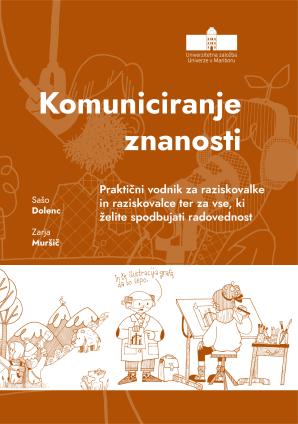
Komuniciranje znanosti: Praktični vodnik za raziskovalke in raziskovalce ter za vse, ki želite spodbujati radovednost
Keywords:
science communication, communication channels, researchers, science communicators, scienceSynopsis
Communicating Science: A Practical Guide for Researchers and Anyone Who Wants to Encourage Curiosity. Would you like to learn how to use science to raise public awareness and how to share information in a way that captures attention, provides clear explanations, and brings science closer to people? Sašo Dolenc and Zarja Muršič will guide you step by step, explaining how to do this in a responsible, professional, and ethical way. The guide is intended for researchers as well as anyone interested in translating scientific findings into language that is accessible to the general public. It is an invaluable tool for those taking their first steps into science communication, while also serving as an excellent resource for those who have already embarked on science communication but want to improve their skills or explore another communication channe
Downloads
Download data is not yet available.
References
Al-Shamahi, E. (2025, 22. september). I'm a former creationist. Here's why 'follow the science' failed. The Washington Post.
Biel, J., in Brent, B. (2022). Make a Zine, Updated & Expanded, Start Your Own Underground Publishing Revolution. Microcosm Publishing, Portland, OR.
Brookshire, B. (2014). Cookie Science: Baking up a scientific experiment. Science News Explores. https://www.sciencenews.org/article/cookie-science-cookie-experiment
Bucchi, M. in Trench, B. (Ur.). (2021). Routledge Handbook of Public Communication of Science and Technology (3. izd.). Routledge. https://doi.org/10.4324/9781003039242
Burns, T. W., O'Connor, D. J. in Stocklmayer, S. M. (2003). Science communication: a contemporary definition. Public Understanding of Science, 12(2), 183–202. https://doi.org/10.1177/09636625030122004
Gopnik, A. (2012). Scientific thinking in young children: Theoretical advances, empirical research, and policy implications. Science, 337(6102), 1623–1627. https://doi.org/10.1126/science.1223416
Gopnik, A., Sobel, D. M., Schulz, L. E., & Glymour, C. (2001). Causal learning mechanisms in very young children: Two-, three-, and four-year-olds infer causal relations from patterns of variation and covariation. Developmental Psychology, 37(5), 620–629. https://doi.org/10.1037/0012-1649.37.5.620
Hammersley, B. (2004, 12. februar). Audible revolution. The Guardian. https://www.theguardian.com/media/2004/feb/12/broadcasting.digitalmedia
Jowett, A. (2008). Podcasting science: A new tool for science communication. EMBO reports, 9(5), 398–401. https://doi.org/10.1038/embor.2008.58
Kahan, D. M. (2017). Misconceptions, Misinformation, and the Logic of Identity-Protective Cognition. Cultural Cognition Project Working Paper Series, št. 164.
Kunaver, U., Muršič, Z., Robinson, J. A. in Romih, T. (2025). Občanska znanost v 5 korakih: Načrtovanje in oblikovanje projektov (P. Fašalek, Ur.). Univerzitetna založba Univerze v Mariboru. https://doi.org/10.18690/um.4.2025
Lastrucci, C. L. (1963). The Scientific Approach: Basic Principles of the Scientific Method. Schenkman Publishing Company.
Lukan, T. (2024). Make Science Go Viral. How to Effectively Communicate Research Through Short Form Video Formats on Social Media Platforms. Alexander von Humboldt Institute for Internet and Society. https://graphite.page/short-video-guide
MacKenzie, L. E. (2019). Science podcasts: analysis of a global audience and podcast practices. Royal Society Open Science, 6(1), 180932. https://doi.org/10.1098/rsos.180932
Medvecky, F. in Leach, J. (2019). An Ethics of Science Communication. Palgrave Pivot. https://doi.org/10.1007/978-3-030-32116-1
Nature Editorial. (2026). The future of science communication is not an article like this. Nature, 654(8117), 8. https://doi.org/10.1038/d41586-026-01723-1
Newman, N., Fletcher, R., Eddy, K., Robertson, C. T. in Nielsen, R. K. (2026). Digital News Report 2026. Reuters Institute for the Study of Journalism. https://reutersinstitute.politics.ox.ac.uk/digital-news-report
Nobel Prize in Physiology or Medicine 2025 (2025). Press release: Mary E. Brunkow, Fred Ramsdell in Shimon Sakaguchi za odkritja na področju periferne imunske tolerance. The Nobel Assembly at Karolinska Institutet.
Olson, R. (2015). Houston, We Have a Narrative: Why Science Needs Story. University of Chicago Press.
Rozenblit, L., in Keil, F. (2002). The misunderstood limits of folk science: An illusion of explanatory depth. Cognitive Science, 26(5), 521–562.
Yong, E. (2021, 2. oktober). What Even Counts as Science Writing Anymore? The Atlantic. https://www.theatlantic.com/science/archive/2021/10/how-pandemic-changed-science-writing/620271/
Published
September 17, 2026
Categories
Copyright (c) 2026 University of Maribor, University of Maribor Press
License

This work is licensed under a Creative Commons Attribution-NonCommercial-NoDerivatives 4.0 International License.
Details about the available publication format: E-book (pdf)
E-book (pdf)
ISBN-13 (15)
978-961-299-197-5
THEMA Subject Codes (93)
PD; PDR; PDZ
COBISS.SI ID (00)
CIP date (35)
2026-09-14
Date of first publication in original language (20)
2026-09-17
Details about the available publication format: Softback (in print)
Softback (in print)
ISBN-13 (15)
978-961-299-198-2
THEMA Subject Codes (93)
PD, PDR, PDZ
COBISS.SI ID (00)
CIP date (35)
2026-09-11
Date of first publication in original language (20)
2026-09-17
Physical Dimensions
16.5cm x 23.5cm x 1cm
How to Cite
Dolenc, S., & Muršič, Z. (2026). Komuniciranje znanosti: Praktični vodnik za raziskovalke in raziskovalce ter za vse, ki želite spodbujati radovednost. University of Maribor Press. https://doi.org/10.18690/um.8.2026