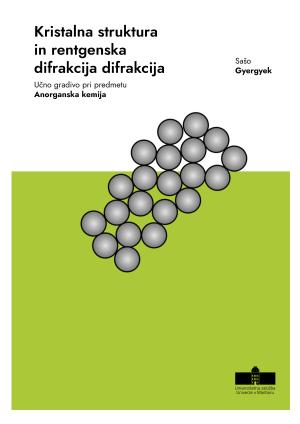
Kristalna struktura in rentgenska difrakcija: Učno gradivo pri predmetu Anorganska kemija
Keywords:
crystal structure, diffraction, symmetry, nanoparticles, peak broadeningSynopsis
Crystal Strucure and X-ray Diffraction: Study Materials for Inorganic Chemistry. This work introduces X-ray diffraction (XRD) as a fundamental method for investigating the structure of crystalline materials, with emphasis on concepts relevant to chemistry and materials science. Crystal structures are first described in terms of lattices, unit cells, symmetry, and crystallographic planes, providing the geometric framework required to understand diffraction. Bragg’s law is then introduced as the condition for constructive interference and related to interplanar spacings and diffraction-peak positions. Atomic scattering and the structure factor are used to explain diffraction intensities, systematic absences, and the sensitivity of X-rays to different elements. The discussion then extends to powder diffraction, including phase identification, crystallite size, peak broadening, preferred orientation, and Rietveld refinement. Particular attention is given to nanoscale materials, where finite crystallite size, strain, disorder, and anisotropic crystallinity influence diffraction patterns. The chapter emphasizes both the structural information obtainable from XRD and its limitations, motivating complementary characterization by electron microscopy.
Downloads
Download data is not yet available.
References
Cullity, B. D., & Stock, S. R. (2001). Elements of X-ray diffraction (3. izd.). Prentice Hall.
Dinnebier, R. E., & Billinge, S. J. L. (Ur.). (2008). Powder diffraction: Theory and practice. Royal Society of Chemistry.
Giacovazzo, C., in sod. (2011). Fundamentals of crystallography (3. izd.). Oxford University Press.
International Union of Crystallography. (b. l.). International tables for crystallography, Volume A: Space-group symmetry. Wiley.
Young, R. A. (Ur.). (1993). The Rietveld method. Oxford University Press.
Downloads
Published
November 25, 2026
Categories
Copyright (c) 2026 University of Maribor, University of Maribor Press
License

This work is licensed under a Creative Commons Attribution-NonCommercial-NoDerivatives 4.0 International License.
Details about this monograph
ISBN-13 (15)
978-961-299-224-8
COBISS.SI ID (00)
THEMA Subject Codes (93)
P; PN
CIP date (35)
2026-11-20
Date of first publication (11)
2026-11-25
How to Cite
Gyergyek, S. (2026). Kristalna struktura in rentgenska difrakcija: Učno gradivo pri predmetu Anorganska kemija. University of Maribor Press. https://doi.org/10.18690/um.fkkt.10.2026