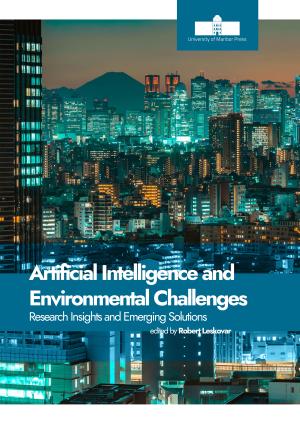
Artificial Intelligence and Environmental Challenges: Research Insights and Emerging Solutions
Keywords:
artificial intelligence, machine learning, environmental issues, CO2 emissions, risk, failure, renewable energy, wind turbine, solar power plant, edge AI, PM2.5 particlesSynopsis
This volume examines where artificial intelligence can provide genuine insight into environmental problems, and at what cost. Across eight chapters, contributors apply machine learning, deep learning, econometric modelling, and computational simulation to a range of pressing challenges: forecasting wind and solar energy output, deploying efficient AI on resource-constrained edge devices, quantifying risk in sustainable finance, detecting faults in photovoltaic installations, analysing air quality and CO₂ emissions data, simulating nanoplastic interactions with biological systems, and modelling urban heat transfer. A recurring theme is the critical importance of data quality — sparse, biased, or poorly curated datasets remain a fundamental obstacle to trustworthy modelling. The volume equally emphasises interpretability, recognising that environmental decision-making is ultimately a human and political process. Taken together, the chapters offer an honest, domain-grounded assessment of the current capabilities and limitations of AI as a tool for addressing environmental challenges.
Chapters
-
Tree-based Machine Learning Methods for Wind Farm Data
-
Edge AI:Small Language Models on the Go
-
Supervised Machine Learning for Renewable Energy
-
Financing Green Solutions:Asset Returns and Tail Risks
-
Fault Detection in Solar Power Plants Based on Energy Production Data
-
Machine Learning for Air Quality and CO2 Emissions:The Role of Data Understanding
-
Nanoplastics and Biostructures:Exploring the Capabilities of MD Computer Simulations
-
Modeling Heat Transfer in an Urban Settlement with 3D Cellular Automata and Artificial Intelligence
Downloads
Download data is not yet available.
References
Downloads
Published
June 18, 2026
Categories
Copyright (c) 2026 University of Maribor, University of Maribor Press

Details about the available publication format: E-book (pdf)
E-book (pdf)
THEMA Subject Codes (93)
UX; TQ
ISBN-13 (15)
978-961-299-160-9
COBISS.SI ID (00)
Date of first publication in original language (20)
2026-06-18
How to Cite
Leskovar, R. (Ed.). (2026). Artificial Intelligence and Environmental Challenges: Research Insights and Emerging Solutions. University of Maribor Press. https://doi.org/10.18690/um.fov.5.2026