AI Anxiety and Workforce Resilience Through ESG Social Responsibility and Adult Education
Kratka vsebina
The rapid integration of Artificial Intelligence (abbreviation: AI) is driving a profound industrial transformation, yet it simultaneously generates considerable anxiety among employees, posing risks to sustainable organizational performance. This paper examines AI-related anxiety within the Hungarian labour market and explores mitigation strategies through the lens of the ESG Social pillar. Adopting a mixed-method approach, combining online surveys to assess learning self-efficacy with qualitative interviews, the research investigates the intersection of technological disruption and human capital management. Findings demonstrate that psychological safety and targeted adult education function not merely as HR instruments but as essential governance mechanisms. Moreover, the data highlight that transparent communication regarding AI deployment alleviates uncertainty and fosters a resilient organizational climate conducive to continuous innovation. The paper argues that navigating AI transformation successfully requires a paradigm shift in management. Sustainable governance must prioritize the human dimension by cultivating trust-based environments.
Prenosi
Strani
399-410
Izdano
3 julija 2026
Kategorije
Avtorske pravice (c) 2026 Univerza v Mariboru, Univerzitetna založba

Kako citirati
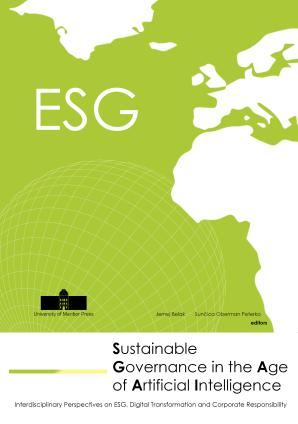
Nagyné Náray, S. S., & Macher, G. Z. (2026). AI Anxiety and Workforce Resilience Through ESG Social Responsibility and Adult Education. V J. Belak & S. Oberman Peterka (Ur.), Sustainable Governance in the Age of Artificial Intelligence: Interdisciplinary Perspectives on ESG, Digital Transformation and Corporate Responsibility (str. 399-410). Univerzitetna založba Univerze v Mariboru. https://doi.org/10.18690/um.epf.7.2026.21