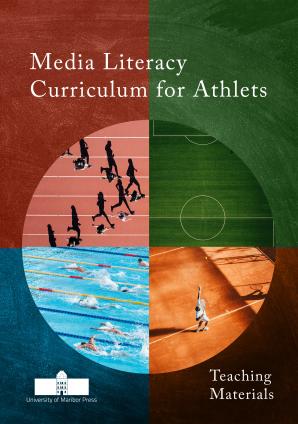
Media Literacy Curriculum for Athletes: Teaching Materials
Keywords:
sport, media literacy, disinformation, reading, olympic valuesSynopsis
The internet and social media have enabled athletes to establish direct contact with the public, fans, the media, and sponsors; at the same time, however, they have increased athletes' exposure to unverified information, sensationalist stories, manipulated content, and pressure to respond quickly. For athletes, therefore, the issue of media literacy is not an abstract topic: it can be linked to their health, public image, and athletic careers, as well as to decisions informed by information on training, nutrition, rehabilitation, or current events.
The OLYMP project—*Fostering Media Literacy and Athlete Empowerment through Olympic Values*—is grounded in the connection among reading, critical thinking, and resilience against disinformation. Its overall goal is to develop and pilot an innovative methodology and curriculum to enhance the media literacy of young athletes and improve their ability to critically evaluate information. The project is funded under the European Union’s Citizens, Equality, Rights and Values (CERV) programme (Grant Agreement No. 101147018).
The project is coordinated by the Bulgarian Olympic Committee (BOC), with a consortium that includes the University of Maribor, the University of Maribor Library (UKM), the Romanian Olympic and Sports Committee (COSR), and the Lithuanian Olympians Association (LOA). The partnership brings together sports and cultural institutions to bring media literacy closer to athletes in the environments where they train, operate, and communicate.
Downloads
Download data is not yet available.
References
Adria Digital Media Observatory. (2026, February 25). What is ADMO? https://admohub.eu/en/
American Psychological Association. (n.d.). Mind over misinformation. https://digital.apa.org/misinformation-effect
American Psychological Association. (n.d.). Misinformation and disinformation. https://www.apa.org/topics/journalism-facts/misinformation-disinformation
Austin, J. (2017, January 25). Usain Bolt stripped of 2008 Olympic medal after anti-doping rule violation. The Independent. https://www.independent.co.uk/sport/olympics/athletics/usain-bolt-stripped-of-2008-olympic-medal-after-antidoping-rule-violation-a7545636.html?utm_source=chatgpt.com
Babson College, Horn Library. (2026, January 15). Evaluating Sources Guide: Techniques. https://libguides.babson.edu/evaluatingsources/techniques
Barry University. (2012, May 5). Shaquille O’Neal graduates from Barry University with doctoral degree in Education. Barry University News. https://my.barry.edu/news/article.html?id=21082
Brock University Library. (2021). Evaluating sources with RADAR [Video]. YouTube. https://www.youtube.com/watch?v=MlFWx4pBKx8
Brown, E. (2025, December 30). Misinformation & fake news: Getting started. Central Washington University Libraries. https://libguides.lib.cwu.edu/c.php?g=625394&p=4360255
Cambridge University Press. (n.d.). Bias. In Cambridge Dictionary. Retrieved June 5, 2026, from https://dictionary.cambridge.org/dictionary/english/bias
CambriLearn. (2024, August 19). Types of reading skills and their purpose. https://cambrilearn.com/blog/types-of-reading-skills
Cockburn, H. (2018, October 2). US basketball star apologises for spreading flat-Earth conspiracy theory. The Independent. https://www.independent.co.uk/news/world/americas/kyrie-irving-flat-earth-theory-basketball-nba-boston-celtics-conspiracy-theories-a8564476.html
College of Staten Island Library. (2026, January 14). Misinformation and disinformation: Thinking critically about information sources: Video: How to spot fake news. https://library.csi.cuny.edu/misinformation/spot-fake-news-video
De Paor, S., & Heravi, B. (2020). Information literacy and fake news: How the field of librarianship can help combat the epidemic of fake news. The Journal of Academic Librarianship, 46(5), 102218. https://doi.org/10.1016/j.acalib.2020.102218
Desai, S., & Oehrli, J. A. (2026, April 27). "Fake news," lies, and misinformation. University of Michigan Library. https://guides.lib.umich.edu/fakenews
Dimov, P. (2021). Recognition of fake news in sports. Strategies for Policy in Science and Education, 29(4s), 18–27. https://doi.org/10.53656/str2021-4s-2-fake
Eckert, S. & Hornung, P. (2018, July 23). Exclusiv im Ersten: Fake Science – Die Lügenmacher [Video]. ARD. https://www.ardmediathek.de/video/dokumentation-und-reportage/exclusiv-im-ersten-fake-science-die-luegenmacher-engl-ut/das-erste/Y3JpZDovL2Rhc2Vyc3RlLmRlL3JlcG9ydGFnZSBfIGRva3VtZW50YXRpb24gaW0gZXJzdGVuL2U1ODIzNWJkLWU2MzQtNDExNC05ZjgwLTNlMDQ0YTJmZWExMw
European Commission. (2026, March 12). Cooperating with fact-checkers, civil society, media and academia. https://commission.europa.eu/topics/countering-information-manipulation/cooperating-fact-checkers-civil-society-media-and-academia_en
European Parliament. (n.d.). How to spot disinformation: The tactics used to trick you [Video]. YouTube. https://www.youtube.com/playlist?list=PLHQxK2YVsFVtlgDH2_lliyTMfPyZ3Q03N
Facing History & Ourselves. (2016, May 8). Defining confirmation bias [Video]. https://www.facinghistory.org/resource-library/defining-confirmation-bias
False posts about ‘new Argentinian banknote featuring Messi’ spread worldwide. (2022, December 28). AFP Fact Check. https://factcheck.afp.com/doc.afp.com.33664AA
Goldhamer, M. (2025, August 19). AI image falsely claimed to show European leaders outside Oval Office. AFP Fact Check. https://factcheck.afp.com/doc.afp.com.69VD6G3
IFLA. (2017). How to spot fake news [Infographic]. https://repository.ifla.org/rest/api/core/bitstreams/448409bb-9e2e-4b7b-9ed7-22f5feaafeb5/content
Laaninen, T. (2025, May). Media literacy: Fostering a key civic skill in a digital information environment. European Parliament Research Service. https://www.europarl.europa.eu/RegData/etudes/BRIE/2025/772886/EPRS_BRI(2025)772886_EN.pdf
Loyola Marymount University, William H. Hannon Library. (2024, July 19). Evaluating sources: Using the RADAR framework. https://libguides.lmu.edu/aboutRADAR
Marcus Rashford. (2026, May 19). In Wikipedia. https://en.wikipedia.org/w/index.php?title=Marcus_Rashford&oldid=20260519
Olimpijski komite Slovenije. (n.d.). Športajmo in berimo. https://www.olympic.si/sportniki/sportajmo-in-berimo
Pachal, P. (2016, November 17). How to improve your Facebook feed, so we see the next Trump coming. Mashable. https://mashable.com/article/avoid-facebook-filter-bubble
Paris, T., Kim, H., Torres, B., Ocampa, K., Janeway, K., & Zimmerman, L. (2017). Rapid genetic and developmental morphological change following extreme celerity. Austin Journal of Pharmacology and Therapeutics, 5(3), 1099. https://st3powers.files.wordpress.com/2018/03/fulltext_ajpt-v5-id1099.pdf
Pariser, E. (2011). Beware online "filter bubbles" [Video]. TED‑Ed. https://ed.ted.com/lessons/beware-online-filter-bubbles-eli-pariser
Pfleegor, A. (2010). Deception in sport: A conceptual and ethical analysis [Master’s thesis, Brock University]. Brock Digital Repository. http://hdl.handle.net/10464/3136
Polger, M. A. [Mark Aaron Polger Information Literacy Videos]. (2020, March 27). Evaluating web cites using the C.R.A.A.P. test [Video]. YouTube. https://www.youtube.com/watch?v=9SRgOAwbRtc
Revez, J., & Corujo, L. (2021). Librarians against fake news: A systematic literature review of library practices (Jan. 2018–Sept. 2020). The Journal of Academic Librarianship, 47(2), 102304. https://doi.org/10.1016/j.acalib.2020.102304
Sailors, P. R., Teetzel, S., & Weaving, C. (2017). Cheating, lying, and trying in recreational sport and leisure practices. Annals of Leisure Research, 20(5), 563–577. https://doi.org/10.1080/11745398.2017.1284009
Sugden, J., & Tomlinson, A. (2017). Football, corruption and lies: Revisiting ‘Badfellas ‘, the book FIFA tried to ban. Routledge. https://doi.org/10.4324/9781315545615
Sullivan, M. C. (2019). Libraries and fake news: What’s the problem? What’s the plan? Communications in Information Literacy, 13(1), 91–113. https://doi.org/10.15760/comminfolit.2019.13.1.7
Tavlin, N. (2015, August 27). How false news can spread [Video]. YouTube. https://www.youtube.com/watch?v=cSKGa_7XJkg
Tenbarge, K. (2024, September 13). The AI-generated Taylor Swift endorsement Trump shared was originally a pro-Biden Facebook meme. NBC News. https://www.nbcnews.com/tech/tech-news/ai-taylor-swift-endorsement-trump-shared-was-originally-biden-meme-rcna170945
The Food Foundation. (n.d.). #EndChildFoodPoverty campaign. https://foodfoundation.org.uk/initiatives/endchildfoodpoverty-campaign
UEFA. (n.d.). Take Care. https://www.uefa.com/takecare/
UNESCO. (2025). Media and information literacy. https://www.unesco.org/en/media-information-literacy
UNICEF. (2025, February 10). A quick guide to spotting misinformation: Tips for fact-checking, staying informed and talking it out. https://www.unicef.org/eca/stories/quick-guide-spotting-misinformation
Vuorikari, R., Kluzer, S., & Punie, Y. (2022). DigComp 2.2, The digital competence framework for citizens: With new examples of knowledge, skills and attitudes. Publications Office of the European Union. https://data.europa.eu/doi/10.2760/115376
Walters, J. (2021, December 3). How do you develop a reading habit at home? Independent Book Review. https://independentbookreview.com/2021/12/03/how-do-you-develop-a-reading-habit-at-home/
Young, J. C., Boyd, B., Yefimova, K., Wedlake, S., Coward, C., & Hapel, R. (2021). The role of libraries in misinformation programming: A research agenda. Journal of Librarianship and Information Science, 53(4), 539–550. https://doi.org/10.1177/0961000620966650
Downloads
Published
September 25, 2026
Categories
Copyright (c) 2026 University of Maribor, University of Maribor Press

Details about this monograph
ISBN-13 (15)
978-961-299-200-2
COBISS.SI ID (00)
THEMA Subject Codes (93)
FG
CIP date (35)
2026-09-16
Date of first publication in original language (20)
2026-09-25
How to Cite
Marinšek, M., Grašič, J., Ferlež, J., Flisar, N., Prezelj Mlakar, M., Šnofl, M., Bedenik, K., Legat, D., & Fras Popović, S. (2026). Media Literacy Curriculum for Athletes: Teaching Materials. University of Maribor Press. https://doi.org/10.18690/um.ukm.3.2026