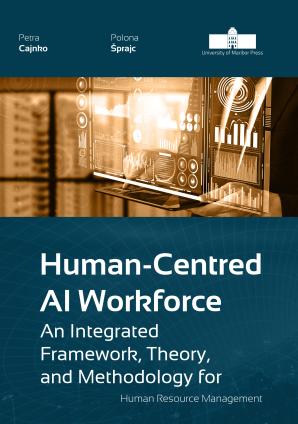
Human-Centred AI Workforce Transformation: An Integtrated Framework, Theory, and Methodology for Strategic Human Resource Managemen
Keywords:
artificial intelligence, AI workforce readiness, strategic human resource management, organisational readiness, employee AI competence, psychological acceptance, institutional governance, human-centred AI transformationSynopsis
Artificial intelligence is increasingly transforming work, leadership, and workforce development, yet technological readiness alone does not ensure successful organisational transformation. This scientific monograph examines organisational and workforce readiness for AI implementation from the perspective of Strategic Human Resource Management. Drawing on an interdisciplinary theoretical review and two empirical studies, it develops the Integrated AI Workforce Readiness Framework (IAWRF), the Dual-Logic AI Workforce Readiness Theory (DLAWR), and the Integrated AI Workforce Readiness Composite Framework (IAWRC). The monograph identifies four interdependent dimensions of AI workforce readiness: Employee AI Competence, Organisational Readiness, Psychological Acceptance, and Institutional Governance. It advances the paradigm of Human-Centred AI Transformation and argues that sustainable AI implementation requires continuous alignment between technological development, organisational preparedness, workforce capability, employee trust, and responsible governance.
Downloads
Download data is not yet available.
References
ALLEA. (2023). The European code of conduct for research integrity (Revised ed. 2023). All European Academies. https://allea.org/code-of-conduct/
Barney, J. (1991). Firm resources and sustained competitive advantage. Journal of Management, 17(1), 99–120. https://doi.org/10.1177/014920639101700108
Becker, G. S. (1964). Human capital: A theoretical and empirical analysis, with special reference to education. University of Chicago Press.
Bernik, N., & Šprajc, P. (2026). Knowledge sharing and sustainable workforce retention among healthcare professionals: Evidence from public healthcare organisations. Sustainability, 18(8), Article 3770. https://doi.org/10.3390/su18083770
Brynjolfsson, E., & McAfee, A. (2014). The second machine age: Work, progress, and prosperity in a time of brilliant technologies. W. W. Norton & Company.
Budhwar, P., Malik, A., De Silva, M. T., & Thevisuthan, P. (2023). AI and human resource management: Challenges and a path forward. Human Resource Management Review, 33(4), 100940. https://doi.org/10.1016/j.hrmr.2022.100940
Cajnko, P., Cajnko, K., & Gomboc, T. (2025). Harnessing coaching skills for children's mental health and well-being. Interacción y perspectiva: Revista de trabajo social, 15(1), 304–317. https://doi.org/10.5281/zenodo.14031943
Creswell, J. W., & Creswell, J. D. (2023). Research design: Qualitative, quantitative, and mixed methods approaches (6th ed.). SAGE.
Davenport, T. H., & Kirby, J. (2016). Only humans need apply: Winners and losers in the age of smart machines. Harper Business.
Davis, F. D. (1989). Perceived Usefulness, Perceived Ease of Use, and User Acceptance of Information Technology. MIS Quarterly, 13(3), 319–340. https://doi.org/10.2307/249008
Denzin, N. K. (1978). The research act: A theoretical introduction to sociological methods (2nd ed.). McGraw-Hill.
DeVellis, R. F., & Thorpe, C. T. (2021). Scale development: Theory and applications (5th ed.). SAGE.
Edmondson, A. C. (2018). The fearless organization: Creating psychological safety in the workplace for learning, innovation, and growth. John Wiley & Sons.
Edmondson, A. C., & McManus, S. E. (2007). Methodological fit in management field research. Academy of Management Review, 32(4), 1155–1179. https://doi.org/10.5465/AMR.2007.26586086
Eisenhardt, K. M. (1989). Building theories from case study research. Academy of Management Review, 14(4), 532–550. https://doi.org/10.2307/258557
European Commission. (2025). AI talent, skills and literacy: Policies to support AI-related competences and education. Retrieved February 19, 2026, from https://digital-strategy.ec.europa.eu/en/policies/ai-talent-skills-and-literacy
European Union. (2016). Regulation (EU) 2016/679 of the European Parliament and of the Council of 27 April 2016 on the protection of natural persons with regard to the processing of personal data and on the free movement of such data, and repealing Directive 95/46/EC (General Data Protection Regulation). Official Journal of the European Union, L 119, 1–88. https://eur-lex.europa.eu/eli/reg/2016/679/oj
European Union. (2024). Regulation (EU) 2024/1689 of the European Parliament and of the Council of 13 June 2024 laying down harmonised rules on artificial intelligence (Artificial Intelligence Act). Luxembourg: Publications Office of the European Union.
Field, A. (2018). Discovering statistics using IBM SPSS Statistics (5th ed.). SAGE Publications.
Floridi, L., & Cowls, J. (2019). A Unified Framework of Five Principles for AI in Society. Harvard Data Science Review, 1(1). https://doi.org/10.1162/99608f92.8cd550d1
Hair, J. F., Black, W. C., Babin, B. J., & Anderson, R. E. (2022). Multivariate data analysis (9th ed.). Cengage.
Harari, Y. N. (2018). 21 lessons for the 21st century. Spiegel & Grau.
Jarrahi, M. H. (2018). AI and the future of work: Human–AI symbiosis in organizational decision making. Business Horizons, 61(4), 577–586. https://doi.org/10.1016/j.bushor.2018.03.007
Javadi, T., Vratar, L., & Cajnko, P. (2025). Career adaptability and sustainable employment in the banking sector: The mediating role of wisdom management. RISUS – Revista de Inovação e Sustentabilidade, 16(3), 223–237. https://doi.org/10.23925/2179-3565.2025v16i3p223-237
Jovanović, T., Šprajc, P., & Arsenijević, O. (2025). Employees’ digital competences and holistic HRM 4.0: Learning challenges in organisations in Serbia. Andragoške studije, (2), 31–46. https://doi.org/10.5937/AndStud2502031J
Kaplan, A., & Haenlein, M. (2020). Rulers of the world, unite! The challenges and opportunities of AI. Business Horizons, 63(1), 37–50. https://doi.org/10.1016/j.bushor.2019.09.003
Kellogg, K. C., Valentine, M. A., & Christin, A. (2020). Algorithms at work: The new contested terrain of control. Academy of Management Annals, 14(1), 366–410. https://doi.org/10.5465/annals.2018.0174
Long, D., & Magerko, B. (2020). What is AI literacy? Competencies and Design Considerations. In Proceedings of the 2020 CHI Conference on Human Factors in Computing Systems (pp. 1–16). ACM. https://doi.org/10.1145/3313831.3376727
Minbaeva, D. (2021). Disrupted HR? Human resource management in the digital age. Human Resource Management Review, 31(1), 100820. https://doi.org/10.1016/j.hrmr.2020.100820
Northouse, P. G. (2022). Leadership: Theory and practice (9th ed.). SAGE Publications.
OECD. (2023). OECD Employment Outlook 2023: AI and the labour market. OECD Publishing. https://doi.org/10.1787/08785bba-en
Roblek, V., Meško, M., & Podbregar, I. (2021). Mapping of the emergence of Society 5.0: A bibliometric analysis. Organizacija, 54(4), 293–305. https://doi.org/10.2478/orga-2021-0020
Teece, D. J. (2018). Business models and dynamic capabilities. Long Range Planning, 51(1), 40–49. https://doi.org/10.1016/j.lrp.2017.06.007
Teece, D. J., Pisano, G., & Shuen, A. (1998). Dynamic capabilities and strategic management. Strategic Management Journal, 18(7), 509–533. https://doi.org/10.1002/(SICI)1097-0266(199708)18:7<509::AID-SMJ882>3.0.CO;2-Z
Turkle, S. (2011). Alone together: Why we expect more from technology and less from each other. Basic Books.
Ulrich, D., & Dulebohn, J. H. (2015). Are we there yet? What's next for HR? Human Resource Management Review, 25(2), 188–204. https://doi.org/10.1016/j.hrmr.2015.01.004
UNESCO. (2021). Recommendation on the ethics of artificial intelligence. Paris: UNESCO.
Venkatesh, V., Morris, M. G., Davis, G. B., & Davis, F. D. (2003). User acceptance of information technology: Toward a unified view. MIS Quarterly, 27(3), 425–478. https://doi.org/10.2307/30036540
Vrontis, D., Christofi, M., Pereira, V., Tarba, S., Makrides, A., & Trichina, E. (2022). Artificial intelligence, robotics, advanced technologies and human resource management: A systematic review. The International Journal of Human Resource Management, 33(6), 1237–1266. https://doi.org/10.1080/09585192.2020.1871398
World Economic Forum. (2025). The Future of Jobs Report 2025. Geneva: World Economic Forum. https://www.weforum.org/publications/the-future-of-jobs-report-2025/
Downloads
Published
September 16, 2026
Categories
Copyright (c) 2026 University of Maribor, University of Maribor Press

Details about this monograph
THEMA Subject Codes (93)
KJMV2; UYQ; KJU
ISBN-13 (15)
978-961-299-201-9
COBISS.SI ID (00)
CIP date (35)
2026-09-16
Date of first publication in original language (20)
2026-09-16
How to Cite
Cajnko, P. (2026). Human-Centred AI Workforce Transformation: An Integtrated Framework, Theory, and Methodology for Strategic Human Resource Managemen. University of Maribor Press. https://doi.org/10.18690/um.fov.8.2026