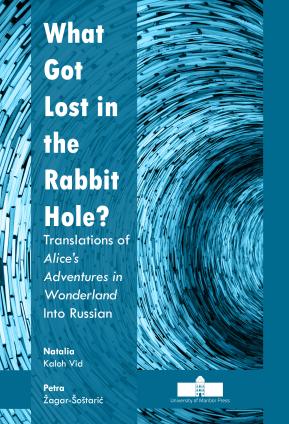
What Got Lost in the Rabbit Hole? Translations of Alice's Adventures in Wonderland into Russian
Ključne besede:
literarno prevajanje; posodabljanje; Alica; angleščina; ruščinaKratka vsebina
Kaj se je izgubilo v zajčji luknji? Prevodi Aličinih dogodivščin v čudežni deželi v ruščino. Literarna dela se v prevodih posodabljajo iz več razlogov, med drugim zaradi izboljšanja kakovosti prejšnje različice, »osvežitve« jezika, približevanja bralca izvirnemu besedilu, prilagajanja prevoda za novo in pogosto popolnejšo izdajo, zmanjševanja razlik in odstopanj od prejšnje različice ali prilagajanja besedila spreminjajočim se normam prevajanja v ciljni družbi. Knjiga se osredotoča na dvanajst prevodov Aličinih dogodivščin v čudežni deželi v ruščino (1909–2000), kar je eden redkih primerov v zgodovini ponovnih prevodov, ki ponuja bogato in dragoceno gradivo za primerjalno študijo. Natančna besedilna analiza izvirnika in prevodov se osredinja na prevode kulturno specifičnih elementov, parodij, osebnih imen, jezikovnih različic, zgodovinskih referenc in drugih slogovnih komponent. Kot so pokazali rezultati analize, prevodi otroške literature ne pomenijo vedno in nujno izključno podomačitve in adaptacije z bolj znanim konceptom iz ciljne kulture.
Prenosi
Podatki o prenosih še niso na voljo.
Literatura
Almberg, S.P.E. 2001. Retranslation. In: S.W. Chan and D.E. Pollard (eds), An encyclopedia of Translation. 925–930. Hong Kong: Chinese University Press.
Auden, Wystan H. 1971. Today’s “Wonder-World” Needs Alice. In Philips, R. (ed.). Aspects of Alice: Lewis Carroll’s Dreamchild as Seen through the Critic’s Looking-Glasses. 3–12. London: Victor Gollancz Ltd.
Baker, Mona. 1992. In Other Words: A Coursebook on Translation. London: Routledge.
Bassnett Susan. 1990. “Translating for the theatre: Textual complex- ities”. Essays in Poetics 15: 7–84.
Bensimon, Paul. 1990. “Présentation.” Palimpsestes 4: ix–xiii.
Berezowski, Leszek. 1997. Dialect in Translation. Wroclaw: Wydawnictwo Uniwesytetu Wroclawskiego.
Berman, Antoine. 2000. “Translations and the Trails of the Foreign.” In Lawrence Venuti (ed.). The Translation Studies Reader. 284–297. New York: Routledge.
Bonaffini, Luigi. 1997: “Translating Dialect Literature. ” World Literature Today 71(2): 279–288.
Boyd, Brian. 1991. Vladimir Nabokov: The American Years. Princeton, NJ: Princeton University Press.
Brisset, Annie. 2004. “Retraduire ou le corps changeant de la connaissance. Sur l’historicité de la traduction.” Palimpsestes 15: 39–67.
Broeder, Linda. 2007. Translating Humour: The Problem with Translating Terry Pratchett. Utrecht: Utrecht University.
Brownlie, Shioban. 2006. “Narrative theory and retranslation theory.” Across Languages and Cultures 7/2: 140–170.
Carroll, Lewis. Alice’s Adventures in Wonderland. 8 February 2021. <https://www.gutenberg.org/files/11/11-h/11-h.htm>
------------- 2021. (trans. Kononenko, Aleksander). Приключения Алисы в стране чудес. [Adventures of Alice in Wonderland]. < http://www.wonderland---.
-------------- 1991. (trans. Jahnin, Leonid). Приключения Алисы в Стране Чудес. [Adventures of Alice in Wonderland]. Pionir 1-3. <https://wysotsky.com/0011/1049-15.htm#09>
--------------1909. (trans. Solovyova, Poliksena). Приключения Алисы в стране чудес [The Adventures of Alice in Wonderland]. Tropinka 2.20.
------------ 1923. (trans. D’Aktil, Anatoly). Алиса в странечудес. [Alice in Wonderland]. Moscow – Petrograd: Publishing house of L. D. Frenkel.
<http://az.lib.ru/k/kerroll_l/text_1865_alices_adventures_in_wonderland_d_aktil.shtml>
-------------- 1923. (trans. Nabokov, Vladimir). Аня в стране чудес. [Anya in Wonderland]. Berlin: Gamayun. <https://www.lib.ru/CARROLL/anya.txt>
---------------1940. (trans. Olenich-Gnenenko, Aleksander). Алиса в стране чудес. [Alice in Wonderland] Rostov na Donu: Rostizdat.
<https://libking.ru/books/child-/child-tale/465059-lyuis-keroll-alisa-v-strane-chudes.html>
------------- 1967. (trans. Demurova, Nina). Алиса в стране чудес. Сквозь зеркало и что там увидела Алиса. [Alice in Wonderland. Through the Glass and what Alice Saw There] Sofia: Publishing House of Literature in Foreign Languages.
<https://www.lib.ru/CARROLL/carrol1_1.txt>
------------- 1971. (trans. Zakhoder, Boris). Алиса в стране чудес. [Alice in Wonderland]. Pioner 12б. <https://www.lib.ru/CARROLL/alisa_zah.txt>
------------- 1977. (trans. Sherbakov, Aleksander). Приключения Алисы в стране чудес. [Adventures of Alice in Wonderland]. Moscow: Khudozhestvennaya literature. <https://wysotsky.com/0011/1049-07.htm>
--------------1988. (trans. Orel, Vladimir). Приключения Алисы в стране чудес. [Adventures of Alice in Wonderland]. Moscow: Detskaya literature. <https://wysotsky.com/0011/1049-03.htm>
--------------1908. (trans. Granstrem, Matilda). Приключения Ани въ мiрѣ чудесъ). [Adventures of Anya in Wonderland]. Saint Petersburg: Publishing house of E. A. Granstrem. <https://rusneb.ru/catalog/000199_000009_003749735/>
--------------1908-1909. (trans. Rozhdestvenskaya, Aleksandra). Приключения Алисы в волшебной стране. [Adventures of Alice in Wonderland]. Zadushevnoye slovo 49: 1–33. <https://rusneb.ru/catalog/000199_000009_003749735/>
---------------------------------------------- (eds.) Alice in a World of Wonderlands: The Translations of Lewis Carroll’s Masterpiece. Volume three, Checklists. New Castle, DE: Oak Knoll Press, 2015.
Chesterman, Andrew. 1998. “From ‘Is’ to “Ought”: Laws, Norms and Strategies in Translation Studies,” Target 5/1: 1–20.
Cronin, Michael. 2003. Translation and Globalization. Routledge: London.
Cohen, Norton M. 1972. “Introduction.” Lewis Carroll. Aventures d’Alice au pays de merveilles, translated by Henri Bué. New York. ii–xii.
Connolly, Julian W. 1995. Anya v strane chudes. In Vladimir E. Alexandrov (ed.) The Garland Companion to Vladimir Nabokov. 18–24. New York: Garland.
Cronin, Michael. 2003. Translation and Globalization. Routledge: London.
Davies, Eirlys E. 2003. “A Goblin or a Dirty Nose?” The Translator: Studies in Intercultural Communication, 9/1: 65–100
Demurova, Nina. 1992. “Алиса на других берегах.” In Alice’s Adventures in Wonderland by Lewis Carroll translated by Vladimir Nabokov 7–28. Moskva: Raduga
Eco, Umberto. 2001. Experiences in Translation, translated by McEwen, A. Toronto: University of Toronto Press.
Gendi, El and Kader, Abdel 2010. Die Äquivalenzproblematik bei der literarischen Übersetzung am Beispiel von Taha Husseins “AlAyyam.” Dissertation. Hamburg: University of Hamburg.
Etkind, Efim. 1963. "Поэзия и перевод". Советский писатель: Ленинградское отделение. 345–379
Franco Aixelá, J. 2000. La traducción condicionada de los nombres propios (inglés-español). Análisis descriptivo. Salamanca: Ediciones Almar
Hönig, Hans G. and Paul Kußmaul. 2003. Strategie der Übersetzung. Tübingen: Gunter Narr Verlag.
Hutcheon, Linda. 1985. A Theory of Parody: The Teachings of Twentieth-Century Art Forms. London:
Methuen & Co.
Gambier, Yves. 2007. Doubts and Directions in Translation Studies. The Netherlands
--------------------1994. “La Retraduction, re Tour et de Tour,” Meta 39: 413–417.
--------------------2011. La retraduction: Ambigüités et défis. In E. Monti & P. Schnyder (Eds.), Autour de la retraduction. Perspectives littéraires européennes. 49–66. Paris: Orizons.
Gardner, Martin, editor. 2000. The Annotated Alice: Alice's Adventures in Wonderland & Through the Looking-Glass. By Lewis Carroll, illustrated by John Tenniel, Definitive Edition, W. W. Norton & Company.
Hemmings, Robert. 2007. “A Taste of Nostalgia: Children’s Books from the Golden Age; Carroll, Grahame, and Milne,” Children’s Literature 35: 54–79.
Hervey, Sandor and Higgins, Ian. 2002.Thinking French Translation. A Course in Translation Method: French to English. London: Routledge,
Hutcheon, Linda. 1985. A Theory of Parody: The Teachings of Twentieth-Century Art Forms. London: Methuen & Co. Ltd.
Imholtz, A. Jr., & Imholtz, Clare. 2014. “Alice Goes to Russia,” Slavic & East European Information Resources 15/3: 150–160.
Jianzhong, Xu. 2003. “Retranslation: Necessary or Unnecessary.” Babel 49/3: 193–202.
Kalashnikov, Aleksander. 2018. “Пародии на нравоучительные стихотворения в «Приключениях Алисы в стране чудес» в русских переводах начала xx век.” [Parodies of didactic poems in Alice’s Adventures in Wonderland in Russian Translations of the beginning of the twentieth century]. Вестник НГУ. Серия: Лингвистика и межкультурная коммуникация 16/1. 96–107.
Kaloh Vid Natalia. 2020. Re-translations to Paratexts to Children’s Literature. The Diversity of Literary Translation. Maribor University Press: Maribor.
-----------------------2017. Translations of Sovietisms: A Comparative Case Study of English Translations of Bulgakov’s The Master and Margarita. Meta 62/1:178–200
------------------------2024. “Culturally Specific Elements in Russian Translations of Alice’s Adventures in Wonderland.” Translation and Literature 33/1: 29–51.
-------------------------2025. Rendering Personal Names in Children’s Literature: Strategies in Russian Translators of Alice’s Adventures in Wonderland. In Pavlikova Z. (ed.) Foreign lanuguages in changing times. 36–50. Economic University of Bratislava: Bratislava.
Kaloh Vid, Natalia and Žagar-Šoštarić, Petra. 2003. “Russian Translations of Parodies of Didactic Verses in Alice's Adventures in Wonderland: What Got Lost in the Rabbit Hole?” International Research in Children’s Literature 16/1: 48–58.
Kibbee, Douglas A. 2003. “When Children’s Literature Transcends its Genre Translating Alice in Wonderland,” Meta 48/1-2: 307–321.
Klingberg, Göte. 1986. Children’s Fiction in the Hands of the Translators. Lund: CWK Gleerup.
Kovačič, Irena. 1991. Jezikovne zvrsti in podnaslovno prevajanje. In Irena Trenc Frelih, Aleš Berger and Jaroslav Skrušny (eds.) 15. prevajalski zbornik. Prevajanje dialektov in žargonov. 20–27. Ljubljana: Zbornik društva slovenskih književnih prevajalcev.
Kußmaul, Paul (ed.).2009. Übersetzen – nicht leicht gemacht. Berlin: SAXA Verlag.
Kohlmayer, Rainer. 2003. Empathie und Rhetorik. Gedanken zur Didaktik des Literaturübersetzens. In Perl, Matthias and Wolfgang Pöckl (eds.). Die ganze Welt ist Bühne. 417–433. Frankfurt am Main: Peter Lang.
Jahr, Silke. 2000. Emotionen und Emotionsstrukturen in Sachtexten. An Interdisciplinary Approach to the Quantitative and Qualitative Description of Textual Emotionality. Berlin / New York: De Gruyter.
Lathey, Gillian. 2015. Translating Children's Literature. London; New York: Routledge, Taylor &Francis Group.
Levý, Jiří. 1963. Umění překladu. Praha: Československý spisovatel.
Lindseth, Jon Lindseth and Tannenbaum, Alan (eds.). 2015. Alice in a World of Wonderlands: The Translations of Lewis Carroll's’s Masterpiece. Volume two, Back-translations. New Castle: DE: Oak Knoll Press.
Meek, Margaret. 2001. Children's Literature and National Identity. Stoke on Trent: UK.
Newmark, Paul. 1988. A Textbook of Translation. New York: Prentice Hall International
Nabokov, Vladimir. 1998. “Iskusstvo Perevoda.” Lekciji po Russkoj Literature. 389–397.
Nic Lochlainn, Caoimhe. 2013. Tarts and Treacle, Roast Potatoes and Buttermilk: Domestication in Irish-language Translations of Children’s Literature. In Nora Maguire and Beth Rodgers (eds.). Children’s Literature on the Move: Nations, Translations, Migrations. 73–86. Dublin: Four Courts Press.
Nikolaeva, Maria. 1996. Children’s Literature Comes of Age. Toward a New Aesthetic. New York/London: Garland Publishing Inc.
Nord, Christiane. 1997. Translating as a Purposeful Activity: Functionalist Approaches Explained. Manchester.
O’Sullivan, E. 2005. Comparative Children's Literature. London: Routledge.
Paloposki, Outi. 2007. “Suomentaminen ja suomennokset 1800-luvulla.” Hannu K. Riikonen, Urpo Kovala, Pekka Kujamäki, Outi Paloposki (hrsg.): Suomennoskirjallisuuden historia. Bd. 1. 102–126. Helsinki: SKS,
--------------------2010. “The Translator’s Footprints.” In. T. Kinnunen & K. Koskinen (Eds.), Translators’ Agency. 86–107. Tampere: Tampere University Press.
Paepcke, Fritz. 1986. Übersetzen zwischen Regel und Spiel. In Berger, Klaus and Hans-Michael Speier (hrsg.) Im Übersetzen leben. Übersetzen und Textvergleich. 121–134. Tübingen: Narr.
Pöckl, Wolfgang. 2004. Zwischen Zufall und Notwendigkeit: Neuübersetzungen. Internationales Archiv für Sozialgeschichte der deutschen Literatur 29/2): 200–210.
Prunč, Erich. 2001. Entwicklungslinien der Translationswissenschaft. Berlin: Frank & Timme GmbH Verlag für wissenschaftliche Literatur.
Puurtinen, Tina. 2006. Translating Children’s Literature: Theoretical Approaches and Empirical Studies, In Gillian Lathey (ed.) The Translation of Children’s Literature A Reader. 54–64. Clevedon: Multilingual Matters,
Pym, Anthony. 1989. Method in Translation History. Manchester: St. Jerome.
------------------.1992. Translation and Text Transfer. Berlin: Peter Lang.
Radegundis, Stolze. 2003. “Translating for Children – World View or Pedagogics?” Meta 48/1(2): 208–221.
Ramos Pinto, Sara. 2009. “How Important Is the Way You Put It? A Discussion on The Translation of Linguistic Varieties.” Target 21/2. 289–307.
Ramovš, Fran. 1935. Historična gramatika slovenskega jezika VII. Dialekti. Ljubljana: Učiteljska tiskarna.
Reichertz, Ronald. 1997. Lewis Carroll’s Uses of Earlier Children’s Literature. McGill-Queen’s University Press.
Rode, Matej. 1991. Narečje kot prevajalski problem. In Irena Trenc Frelih, Aleš Berger and Jaroslav Skrušny (eds.) 15. prevajalski zbornik. Prevajanje dialektov in žargonov. 28–31. Zbornik društva slovenskih književnih prevajalcev: Ljubljana.
Rose, Margaret E. 1993. Parody: Ancient, Modern, and Post-modern. Cambridge: Cambridge University Press.
Sameh Fekry, Hanna. 2006. Towards a Sociology of Drama Translation: A Bourdieusian Perspective on Translations of Shakespeare’s Great Tragedies in Egypt. Unpublished PhD dissertation. University of Manchester, Centre for Translation and Intercultural Studies.
Schleiermacher, Friedrich. 1963. Methoden des Übersetzens. Störig, In Hans Joachim (ed.) Das Problem des Übersetzens. 38–70. Darmstadt: Wissenschaftliche Buchgesellschaft.
Siladji, Karolj. 1991. Na ivici mogućeg i nemogučeg. In Irena Trenc Frelih, Aleš Berger and Jaroslav Skrušny (eds.): 15. prevajalski zbornik. Prevajanje dialektov in žargonov. 32–35. Ljubljana: Zbornik društva slovenskih književnih prevajalcev.
Shavit, Zohar. 1980. “The Ambivalent Status of Texts: The Case of Children’s Literature”. Poetics
Today 1/3: 75–86.
Shires, Linda M. 1988. “Fantasy, Nonsense, Parody and the Status of the Real: The Example of Carroll.” Victorian Poetry 26/3: 267–283.
Stolze, Radegundis. 1992. Übersetzungstheorien. Tübingen: Narr Francke Attempto Verlag GmbH & Co. KG.
Sullivan, Emer. 2000. Kinderliterarische Komparatistik. Heidelberg: Universitätsverlag C. Winter.
Susam-Sarajeva, Sebnem. 2003. “Multiple-entry Visa to Travelling Theory: Retranslations of Literary and Cultural Theories,” Target 15: 1–36.
Sutherland, Robert D. 1985. “Hidden Persuaders: Political Ideologies in Literature for Children.” Children’s Literature in Education 16/3:143–57.
Thome, Gisela. 2012. Übersetzen als intralinguales und interkulturelles Sprachhandeln. Berlin: Frank & Timme GmbH Verlag.
Tiittula, Liisa and Nuolijärvi, Pirkko. 2013. Puheen illuusio suomalaisessa kaunokirjallisuudessa. Helsinki: SKS.
Van Coillie, Jan. 2014. Character Names in Translation: A Functional Approach. In Van Coillie, Jan and Walter P (eds.). Verschueren, Children’s Literature in Translation: Challenges and Strategies. 123 – 39. London and New York: Routledge.
Vanderschelden, Isabelle. 2000. Why Retranslate the French Classics? The Impact of Retranslation on Quality. In M. Salama-Carr (ed.) On Translating French Literature and Film II. 1–18. Amsterdam: Rodopi.
Venuti, Lawrence. 2006. Translation as Cultural Politics: Regimes of Domestication in English. In Daniel Weissbort and Astradur Eysteinsson (eds). Translation Theory and Practice: A Historical Reader. Oxford: Oxford University Press.
---------------------.1995. The Translator’s Invisibility: A History of Translation. London and New York: Routledge.
--------------------.2004. “Retranslations: The Creation of Value.” Translation and Culture. Special Issue of Bucknell Review 47/1: 25–38.
Vid, Natalia. 2008. “Domesticated translation: the case of Nabokov’s translation of Alice’s Adventures in Wonderland”. NOJ / НОЖ: Nabokov Online Journal Vol. II.
Witte, Heidemarie. 2007. Die Kulturkompetenz des Translators. Conceptual foundations and didactic approaches. Tübingen: Stauffenburg.
Woodsworth, Judith. 1996. “Language, Translation and the Promotion of National Identity: Two Test Cases.” Target 8/2: 21–38.
Zohar, Shavit. 1980. “The Ambivalent Status of Texts: The Case of Children's’s Literature.” Poetics Today 1/3: 75–86.
Žagar-Šoštarić, Petra and Manuela Svoboda. 2014. Leicht gedacht und schwer gemacht. Zur Problematik des literarischen Übersetzens. In Đurović, Annette and Vlasta Kučiš (eds.): Translation und transkulturelle Kommunikation. 217–239. Belgrade: University of Belgrade, Faculty of Philology.
Žagar-Šoštarić, Petra and Sintija Čuljat. 2014. Književno prevođenje. In Stojić, Aneta, Marija Brala Vukanović, and Mihaela Matešić (eds.). Priručnik za prevoditelje. 93–134. Rijeka: Faculty of Humanities and Social Sciences, University of Rijeka.
Prenosi
Izdano
17 aprila 2026
Kategorije
Avtorske pravice (c) 2026 Univerza v Mariboru, Univerzitetna založba

Podrobnosti o monografski publikaciji
THEMA Subject Codes (93)
DS, DSY
ISBN-13 (15)
978-961-299-135-7
COBISS.SI ID (00)
CIP date (35)
17.04.2026
Kako citirati
Kaloh Vid, N., & Žagar-Šoštarić, P. (2026). What Got Lost in the Rabbit Hole? Translations of Alice’s Adventures in Wonderland into Russian. Univerzitetna založba Univerze v Mariboru. https://doi.org/10.18690/um.ff.5.2026